User in Python
In Python programming, the concept of a "user" is integral to the development of applications, particularly those that involve interaction with end-users. A "user" typically refers to an entity that interacts with a software application, performing various actions and operations. This entry synthesizes information from several Python books to provide a comprehensive understanding of how users are managed and interacted with in Python applications.
User Models and Management
In applications like MyBlog, the User model is a central component for managing user data and interactions. This model is responsible for handling personal details, authentication, and user roles. It is often implemented using frameworks like Flask and SQLAlchemy, which facilitate database operations and user session management.
User Model Example
The User model is typically defined using SQLAlchemy, inheriting from UserMixin and db.Model to integrate seamlessly with Flask's login management. Here is an example of a User model:
class User(UserMixin, db.Model):
    __tablename__ = "user"
    user_uid = db.Column(db.String, primary_key=True, default=get_uuid)
    first_name = db.Column(db.String, nullable=False)
    last_name = db.Column(db.String, nullable=False)
    email = db.Column(db.String, nullable=False, unique=True, index=True)
    hashed_password = db.Column("password", db.String, nullable=False)
    active = db.Column(db.Boolean, nullable=False, default=False)
    created = db.Column(db.DateTime, nullable=False, default=datetime.utcnow)
    updated = db.Column(db.DateTime, nullable=False, default=datetime.utcnow, onupdate=datetime.utcnow)

    def get_id(self):
        return self.user_uid

    @property
    def password(self):
        raise AttributeError("user password can’t be read")

    @password.setter
    def password(self, password):
        self.hashed_password = generate_password_hash(password)

    def verify_password(self, password):
        return check_password_hash(self.hashed_password, password)

    def __repr__(self):
        return f"""
        user_uid: {self.user_uid}
        name: {self.first_name} {self.last_name}
        email: {self.email}
        active: {'True' if self.active else 'False'}
        """
Key Attributes and Methods
- Attributes: The model includes attributes like
user_uid,first_name,last_name,email, andhashed_password, which are essential for storing user information. - Password Handling: Methods for setting and verifying passwords ensure that passwords are securely hashed before storage.
- Timestamps: Attributes like
createdandupdatedautomatically track when a user record is created or modified.
User Roles and Permissions
Users can be assigned different roles that determine their permissions within an application. Common roles include:
- Administrator: Has the highest level of access, managing content and users.
- Editor: Can manage content but may have limited user management capabilities.
- Registered User: Can interact with content but has restricted administrative access.
User Interactions
Following Posts
Users can follow posts, and this relationship is managed through a many-to-many association. The User class may have a posts_followed attribute, representing the posts a user is following.
Notifications
Functions like notify_root_post_followers() are used to notify users of updates to posts they follow, enhancing user engagement and interaction.
User Interaction and Error Handling
Understanding user behavior and handling errors gracefully is crucial for creating robust applications. Users may make mistakes, such as entering invalid input, and it is essential to anticipate these errors and handle them effectively.
Importance of Graceful Error Handling
Graceful error handling ensures that a program can manage user errors without crashing. It provides clear feedback and guidance, improving the user experience and increasing the program's reliability.
Entity Relationship Diagram
The following figure illustrates the entity relationship diagram (ERD) of the User table, showing its fields and their data types:
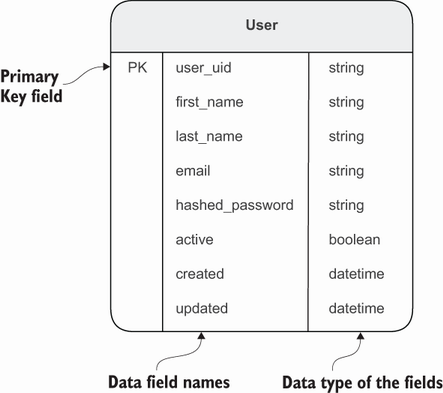 Figure 8.2 The ERD (entity relationship diagram) of the User table showing its fields and their data types
In summary, the concept of a "user" in Python applications encompasses user data management, role-based access control, interaction handling, and error management, all of which contribute to creating a user-friendly and robust application.
| Book Title | Usage of user | Technical Depth | Connections to Other Concepts | Examples Used | Practical Application |
|------------|---------------|-----------------|-------------------------------|---------------|-----------------------|
| [The Well-Grounded Python Developer: How the pros use Python and Flask](https://www.manning.com/books/the-well-grounded-python-developer) | Discusses the `User` model in the context of a Flask application, focusing on user data management, roles, and interactions. [more](https://livebook.manning.com/book/the-well-grounded-python-developer/chapter-8/74) | Explores SQLAlchemy integration, user authentication, and role management. [more](https://livebook.manning.com/book/the-well-grounded-python-developer/chapter-8/48) | Connects user management with database operations, authentication, and role-based access control. [more](https://livebook.manning.com/book/the-well-grounded-python-developer/chapter-9/91) | Provides code examples for user model implementation and role assignment. [more](https://livebook.manning.com/book/the-well-grounded-python-developer/chapter-8/48) | Focuses on practical applications in web development using Flask. [more](https://livebook.manning.com/book/the-well-grounded-python-developer/chapter-8/48) |
| [Python How-To](https://www.manning.com/books/python-how-to) | Describes users as entities interacting with web applications, focusing on session management and user operations. [more](https://livebook.manning.com/book/python-how-to/chapter-14/206) | Covers basic user class implementation and data retrieval operations. [more](https://livebook.manning.com/book/python-how-to/chapter-9/203) | Discusses user session management and data handling in web applications. [more](https://livebook.manning.com/book/python-how-to/chapter-9/203) | Includes examples of user class creation and follower retrieval. [more](https://livebook.manning.com/book/python-how-to/chapter-9/203) | Emphasizes efficient data retrieval and session management in web applications. [more](https://livebook.manning.com/book/python-how-to/chapter-9/203) |
| [A Pythonic Adventure: From Python basics to a working web app](https://www.manning.com/books/a-pythonic-adventure) | Focuses on user interaction and error handling, highlighting the importance of understanding user behavior. [more](https://livebook.manning.com/book/a-pythonic-adventure/chapter-4/1) | Discusses strategies for graceful error handling in software development. [more](https://livebook.manning.com/book/a-pythonic-adventure/chapter-4/1) | Connects user behavior with error handling and software robustness. [more](https://livebook.manning.com/book/a-pythonic-adventure/chapter-4/1) | Provides insights into handling user errors and improving user experience. [more](https://livebook.manning.com/book/a-pythonic-adventure/chapter-4/1) | Aims to enhance user experience by implementing effective error handling strategies. [more](https://livebook.manning.com/book/a-pythonic-adventure/chapter-4/1) |
FAQ (Frequently asked questions)
What are user errors in a program?
Why is it important to handle user errors gracefully?
What does the ERD of the User table show?
What is the purpose of the User model in the code snippet?
What are some key attributes of the User model?
How does the User model handle passwords?
How is the User model used in the MyBlog application?
What roles are assigned to users in the MyBlog application?
What permissions do different user roles have in the MyBlog application?
How are administrator users designated in the MyBlog application?
What permissions do administrator users have in the MyBlog application?
How is the relationship between users and posts managed in the MyBlog application?
Is the posts_followed attribute stored in the database?
What is the purpose of the notify_root_post_followers() function?
How is a User class created in Python?
What does the _get_profile_data method do in the User class?
How can you get followers for a user in Python?
How are user activities tracked in a web app?
What actions can a user perform in a web app?