Connection Pool in Rust
A connection pool is a fundamental concept in managing database connections efficiently within Rust applications. It involves maintaining a set of open database connections that can be reused, thereby reducing the overhead associated with establishing a new connection for each database operation. This is particularly advantageous in environments where multiple queries need to be executed concurrently, such as in web services.
Connection Pool in Rust Web Development
In the context of Rust web development, a connection pool allows multiple database queries to run concurrently in an asynchronous environment. This approach helps manage database load and improve performance by enabling more efficient use of resources. Libraries such as SQLx are commonly used to implement connection pools in Rust applications.
Implementation
To set up a connection pool for a PostgreSQL database using SQLx, you can follow the example below:
use tokio::sync::RwLock;
use std::collections::HashMap;
use std::sync::Arc;
use sqlx::postgres::{PgPoolOptions, PgPool, PgRow};
use sqlx::Row;

use crate::types::{
    answer::Answer,
    question::{Question, QuestionId},
};

#[derive(Debug, Clone)]
pub struct Store {
    pub connection: PgPool, // Connection pool field
}

impl Store {
    pub async fn new(db_url: &str) -> Self {
        let db_pool = match PgPoolOptions::new()
        .max_connections(5)
        .connect(db_url).await {
            Ok(pool) => pool,
            Err(e) => panic!("Couldn't establish DB connection:[]", e), // Error handling
        };

        Store {
            connection: db_pool,
        }
    }

    fn init() -> HashMap<QuestionId, Question> {
        let file = include_str!("../questions.json");
        serde_json::from_str(file).expect("can't read questions.json")
    }
}
In this example, the Store struct is updated to include a connection field, which holds the connection pool for the PostgreSQL database. The new function initializes the connection pool using PgPoolOptions and sets a maximum of 5 connections. If the connection cannot be established, the application will panic.
Usage
The connection pool is stored in the connection field of the Store object. This allows the creation of a new store that can be passed down to route handlers, enabling them to use a connection from the pool to perform database queries as needed.
Visual Representation
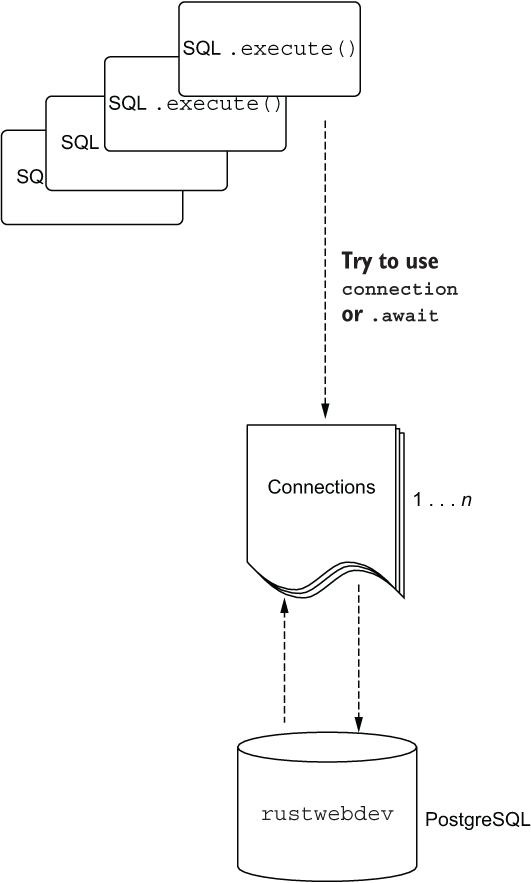 Figure 7.2 Connection pools allow us to keep more than one connection to the database open so we can process more database operations at the same time.
Connection Pool in Rust Servers, Services, and Apps
In Rust applications, a connection pool is a crucial component for managing database connections efficiently. It acts as a repository of database connections that can be reused, reducing the overhead of establishing a new connection each time a database operation is required. This is particularly beneficial in web services where multiple worker threads may need to access the database concurrently.
By integrating a connection pool into the application state, it can be shared across different worker threads, enhancing the performance and scalability of the web service. The use of a connection pool not only optimizes resource utilization but also improves the application's responsiveness by minimizing the time spent on establishing database connections. This is especially important in high-load scenarios where the demand for database access is high.
In summary, a connection pool is an essential tool for efficient database management in Rust applications, enabling shared access to database connections across multiple threads and improving overall application performance.
For more detailed information, you can refer to the Rust Web Development and Rust Servers, Services, and Apps books.
| Book Title | Usage of Connection Pool | Technical Depth | Connections to Other Concepts | Examples Used | Practical Application |
|------------|--------------------------|-----------------|-------------------------------|---------------|-----------------------|
| [Rust Web Development](https://www.manning.com/books/rust-web-development) | Discusses maintaining multiple database connections open simultaneously to improve performance in asynchronous environments. [more](https://livebook.manning.com/book/rust-web-development/chapter-7/78) | Provides detailed implementation using SQLx for PostgreSQL, including error handling and connection limits. [more](https://livebook.manning.com/book/rust-web-development/chapter-7/78) | Connects to asynchronous programming and resource management. [more](https://livebook.manning.com/book/rust-web-development/chapter-7/78) | Includes a code example for setting up a connection pool with SQLx. [more](https://livebook.manning.com/book/rust-web-development/chapter-7/99) | Demonstrates practical use in web development by integrating the connection pool into route handlers. [more](https://livebook.manning.com/book/rust-web-development/chapter-7/78) |
| [Rust Servers, Services, and Apps](https://www.manning.com/books/rust-servers-services-and-apps) | Highlights the importance of reusing database connections to reduce overhead in web services. [more](https://livebook.manning.com/book/rust-servers-services-and-apps/chapter-4/151) | Explains the role of connection pools in enhancing performance and scalability by sharing connections across threads. [more](https://livebook.manning.com/book/rust-servers-services-and-apps/chapter-4/151) | Discusses integration with application state and its impact on performance. [more](https://livebook.manning.com/book/rust-servers-services-and-apps/chapter-4/151) | No specific examples provided, focuses on conceptual understanding. [more](https://livebook.manning.com/book/rust-servers-services-and-apps/chapter-4/151) | Emphasizes the importance in high-load scenarios for efficient database management. [more](https://livebook.manning.com/book/rust-servers-services-and-apps/chapter-4/151) |
FAQ (Frequently asked questions)
What is a connection pool used for?
How is a connection pool set up in the book 'Rust Servers, Services, and Apps'?
What are connection pools in database management?
How do connection pools improve database performance?
What is the purpose of connection pools in database operations?