GET Method in Rust Web Development
The GET method is a fundamental HTTP method used to request data from a server. In the context of Rust web development, particularly when using the Warp framework, the GET method is employed to handle incoming HTTP GET requests and return responses, typically in JSON format.
Overview of the GET Method
The GET method is designed to receive an HTTP GET message and send back an appropriate response. When using Warp, a popular web framework in Rust, this involves setting up a route handler that processes incoming GET requests. The handler retrieves data, such as questions from an in-memory store, and sends it back to the client in a structured format.
Implementing a GET Route with Warp
To implement a GET route in Warp, you need to define a route handler function that specifies how to process the request and generate a response. Below is an example of how to add a route handler for GET requests:
[Listing 3.4: Adding Our First Route Handler](https://livebook.manning.com/book/rust-web-development/chapter-3/48)
use warp::Filter;

...

async fn get_questions() -> Result<impl warp::Reply, warp::Rejection> {   #1
    let question = Question::new(                                         #2
        QuestionId::from_str("1").expect("No id provided"),
        "First Question".to_string(),
        "Content of question".to_string(),
        Some(vec!("faq".to_string())),
    );

    Ok(warp::reply::json(                                                #3
      &question
    ))
}


#[tokio::main]
async fn main() {
    let get_items = warp::get()                                          #4
        .and(warp::path("questions"))
        .and(warp::path::end())                                          #5
        .and_then(get_questions);

    let routes = get_items;                                              #6

    warp::serve(routes)                                                  #7
        .run(([127, 0, 0, 1], 3030))
        .await;
}
In this example, the get_questions function is defined to handle GET requests. It creates a Question object and returns it as a JSON response. The main function sets up the server to listen for GET requests at the /questions endpoint.
Workflow of Handling GET Requests
The process of handling GET requests with Warp involves several steps, as illustrated in Figure 3.2. This figure provides a visual representation of the workflow, including sending, parsing, and answering HTTP GET requests.
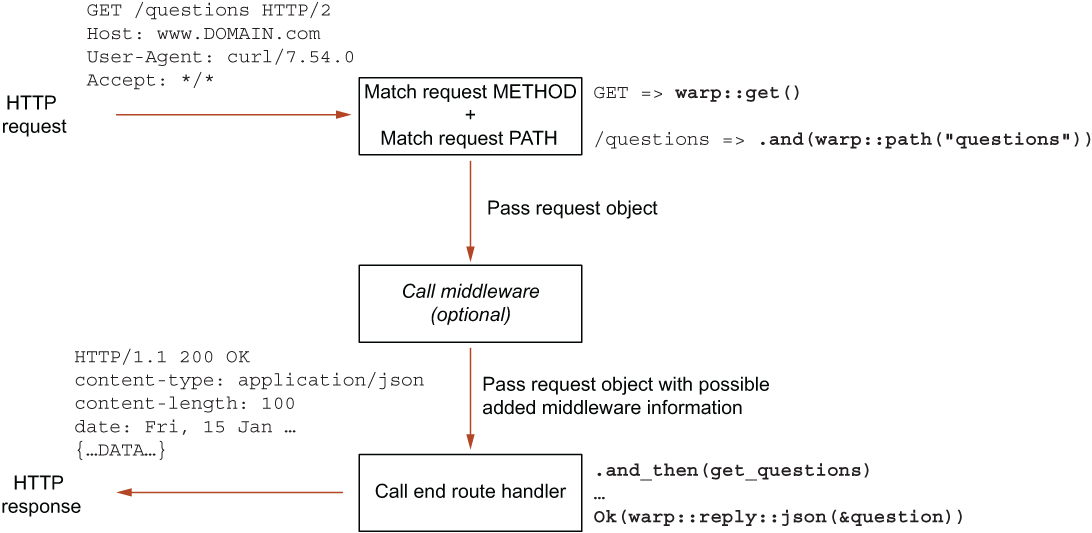 Figure 3.2 Workflow of sending, parsing, and answering HTTP GET requests with Warp
The figure shows the sequence of method calls required to process GET requests using Warp. While the specifics may vary slightly for other HTTP methods like POST, PUT, or DELETE, the overall design principles remain consistent across different frameworks.
Future Developments
In subsequent chapters, additional HTTP methods such as POST, PUT, and DELETE will be introduced, along with the Answer type. Figure 4.1 provides an overview of the endpoints planned for implementation, highlighting the expansion beyond the GET route for questions.
 Figure 4.1 We implemented the GET route for questions in chapter 3; this chapter covers POST, PUT, and DELETE, as well as adding comments via POST.
This progression will eventually lead to the integration of a real database, replacing the initial in-memory storage setup.
FAQ (Frequently asked questions)
What is the GET method used for in Rust Web Development?
What does Figure 3.2 illustrate in the context of Warp?
How do you add a route handler for GET requests in Warp?
What does the get_questions function do in the provided code?
How is the GET method used in chapter 4.1 of Rust Web Development?