Idiom in Rust Programming
Definition of Idiom
In the context of programming, idioms refer to the conventions and styles that are commonly accepted and practiced within a particular programming language. These idioms generally relate to the code itself, including syntax, code formatting, naming conventions, and overall code style. They represent the lowest level of abstraction when compared to design patterns and architecture. While idioms focus on the finer details of writing code, they play a crucial role in ensuring that the code is readable, maintainable, and consistent across different parts of a project or among different projects.
Hierarchy of Abstraction
To better understand the role of idioms, it is helpful to consider the hierarchy of abstraction in software development. This hierarchy is composed of three levels:
- Idioms: The foundational level, focusing on the specifics of code writing and style.
- Design Patterns: The middle level, which involves reusable solutions to common problems in software design.
- Architecture: The highest level, which encompasses the overall structure and organization of a software system.
This hierarchical relationship is visually represented in Figure 1.1.
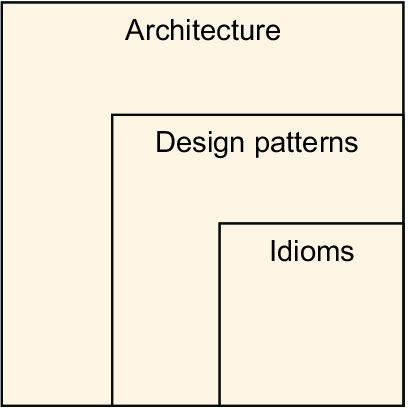 Figure 1.1 Hierarchy of idioms, patterns, and architecture
In this hierarchy, the architecture of any system is composed of many smaller units of design patterns, which are in turn composed of many idioms. This layered approach allows developers to build complex systems by starting with the smallest building blocks (idioms) and working up to the overall system architecture.
Evolution of Idioms
Just as spoken and written languages evolve over time, so do programming languages and their idioms. New idioms may emerge as programming languages evolve and as new features are introduced. Conversely, older idioms may fall out of favor as they become less relevant or as better practices are developed. This dynamic nature of idioms ensures that programming languages remain adaptable and continue to meet the needs of developers.
FAQ (Frequently asked questions)
What are idioms in programming?
How do idioms compare to patterns and architecture?
What does Figure 1.1 in 'Idiomatic Rust' illustrate?