concept library in category c#

This is an excerpt from Manning's book C# in Depth, Fourth Edition.
Every new version of C# has introduced features that I’ve been able to use in Noda Time, so I think it makes sense to use those as concrete examples in this book. All of the code is available on GitHub, which means you can clone it and experiment for yourself. The purpose of using Noda Time in examples isn’t to persuade you to use the library, but I’m not going to complain if that happens to be a side effect.
The .NET ecosystem is pretty rich and is getting better all the time. Developers are creating all kinds of interesting libraries, and I suspect some may embrace dynamic typing. For example, I can imagine a library designed to allow for easy prototyping with REST- or RPC-based APIs with no code generation involved. That could be useful in the initial phase of development while everything is quite fluid before generating a statically typed library for later development.
This is an excerpt from Manning's book Real-World Functional Programming with Examples in F# and C#.
Windows Presentation Foundation (WPF) is a .NET library for creating user interfaces. The library supports the declarative programming style. It separates the part that describes the UI from the part that implements the imperative program logic. But the best practice in WPF is to minimize the program logic and create as much as possible in the declarative way.
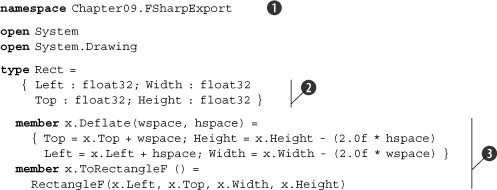
Our main example in this chapter will be a library for creating animations. We’ll use a bottom-up approach when describing the library. This means that for most of the chapter we’ll be talking about very simple things. We’ll look at a couple of primitives for representing values that change with the time and a simple representation of drawings. The beauty of a composable library is that each piece is easy to build, understand, and test. The power is demonstrated when we start putting these building blocks together. In this case we’ll not only combine primitives from the same domain, but we’ll bring two domains together: a drawing that varies over time is practically the definition of an animation. This is a bit like using LINQ to XML, which is an XML API designed to work well with LINQ to Objects. When libraries can be combined in a natural way, it can lead to readable and flexible code.

This is an excerpt from Manning's book ASP.NET AJAX in Action.
As we stated previously, the heart of the client framework is the Microsoft Ajax Library, also known as the core library. The library consists of a set of JavaScript files that can be used independently from the server features. We’ll ease into the core library by explaining the intentions of each of its pieces or layers, beginning with its foundation: the type system.
The Microsoft Ajax Library provides a rich set of tools for managing nearly every aspect of client development. The library isn’t just a simple framework for sending asynchronous requests using the XMLHttpRequest object. Instead, one of its main goals is to bring to the client side many coding patterns familiar to .NET developers. Such .NET flavors include the possibility of exposing multicast events in JavaScript objects and leveraging a component model on the client side. The library also enhances the JavaScript language’s type system and lets you write client code using object-oriented constructs like classes and interfaces. In addition, you can easily access local web services using JavaScript and deal with the ASP.NET application services, such as membership and profile, from the client side. Nonetheless, this is just a taste of the goodies provided by the library.

Ajax— The library isn’t exempt from providing a communication layer for sending asynchronous HTTP requests using the XMLHttpRequest object. Chapter 5 is entirely dedicated to the networking layer.