concept workflow in category c#

This is an excerpt from Manning's book Functional Programming in C#: How to write better C# code.
Workflows are a powerful way of understanding and expressing application requirements. A workflow is a meaningful sequence of operations leading to a desired result. For example, a cooking recipe describes the workflow for preparing a dish.
Workflows can be effectively modeled through function composition. Each operation in the workflow can be performed by a function, and these functions can be composed into function pipelines that perform the workflow—just as you saw in the previous example involving data flowing through different transformations in a LINQ query.
This is an excerpt from Manning's book Real-World Functional Programming with Examples in F# and C#.
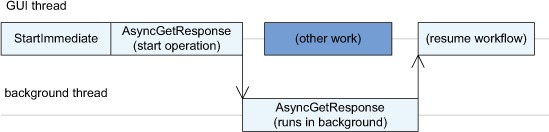
In the previous chapter we saw that F# code written using a computation expression is translated into an expression that uses the primitives provided by the appropriate computation builder. For asynchronous workflows, this means that the let! construct is translated into a call to async.Bind, and return is translated into async.Return. In addition, asynchronous workflows are delayed. This means that the computation itself needs to be wrapped in an additional primitive to make sure that the whole code will be enclosed in a function. The function can then be executed later when we start the workflow. Listing 13.3 shows the translated version of the workflow from listing 13.2.
Listing 13.3. Asynchronous workflow constructed explicitly (F#)
async.Delay(fun () -> let request = HttpWebRequest.Create(url) async.Bind(request.AsyncGetResponse(), fun response -> async.Using(response, fun response -> let stream = response.GetResponseStream() async.Using(new StreamReader(stream), fun reader -> reader.AsyncReadToEnd() ) ) ) )The Delay member wraps a function into a workflow value that can be executed later. The body of the lambda function used as an argument creates an HTTP request and assigns a value to the resp symbol using customized asynchronous value binding. The compiler translated each use binding into a call to the Using member, which is another primitive that can be optionally provided by the computation expression builder. It takes care of disposing of objects at the end of the workflow in case of both success and an error.
The Delay member is one of the computation builder members that we can provide when implementing a computation expression. In listing 13.3, it takes a function that returns the asynchronous workflow (the type is unit -> Async<'a>) and returns a workflow value (Async<'a>) that wraps this function. Thanks to this primitive, the whole computation is enclosed inside a function, and it isn’t executed when we create the Async<'a> value. This is an important difference from the examples in the previous chapter such as the option<'a> type. An option represents a value, so the computation expression runs immediately, performing the computation and returning a new option value, but a workflow represents a computation. It will become clearer what this means when we look at the Async<'a> type in detail.
The essential part of the application that implements the counting is a single recursive function that’s implemented as an asynchronous workflow ❶. The function appears to create an infinite loop, which sounds suspicious to start with. The construct is completely valid, because it starts by waiting for a MouseDown event ❷. This is done asynchronously, which means that the workflow will install the event handler and the rest will only be executed when the user clicks the label. Once the event occurs, we update the text and loop with the incremented counter ❸.