concept most_fields in category elasticsearch

This is an excerpt from Manning's book Relevant Search: With applications for Solr and Elasticsearch.
When users specify multiple criteria, such as “Star Trek Patrick Stewart” or “Star Trek Patrick Stewart William Shatner,” the search becomes more about the aggregate sum of multiple signals. If you choose one signal to emphasize, such as “this search mentions the movie title,” you’ll miss other criteria the user tells you about. You saw one way to begin to fix this, with the best_field parameter tie_breaker. Satisfying these use cases with best_fields and tie_breaker begins to look more like the behavior of most_fields. Remember, most_fields runs a Boolean query of each underlying field. This has the effect of summing the underlying signals:
score = (Stitle + Soverview + Scast.name + Sdirectors.name) × coordThinking of most_fields as a set of Boolean SHOULD clauses helps you see how you ought to use it; these SHOULD clauses list all the criteria of the most relevant doc in terms of the signals that correspond to each field:
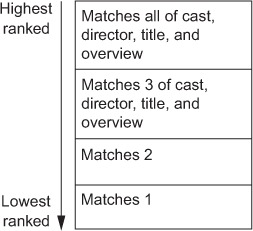
When users specify multiple criteria, ranking by combining the signals that match tends to better align with their expectations. Whereas best_fields would have worked hard to create lopsided results, most_fields creates a blend of all the provided field scores. When users’ expectations don’t prioritize one field or another, but rather prefer an ad hoc collection of multiple fields, most_fields is a great option. The ideal document in best_fields is one that matches one field over another. In the previous example, you pushed title to dominate the scoring. The most_fields strategy obsesses less about one field score, instead letting every field score have a say. When users don’t have as clear of a “target” in terms of a specific kind of field to match, and instead list many criteria of equal importance, most_fields is the solution.