concept relevance engineer in category elasticsearch

This is an excerpt from Manning's book Relevant Search: With applications for Solr and Elasticsearch.
Relevance engineers, though, aren’t the sales department. When a user types “sushi” into the search bar, what restaurants does that user expect? Takeout? High-end restaurants? Nearby ones? Depends on the user? Others in the organization, not the relevance engineer, understand what goals users hope to achieve. The relevance engineer is working in isolation to define relevance ranking and might as well be painting a house blindfolded.
Further, this collaboration goes beyond simply educating the relevance engineer. Curation, the manipulation of content to be easily found by user searches, can matter just as much as teaching a relevance engineer. Recall the expert search examples earlier in this chapter. Here the expertise of the librarian can help you build better search by organizing content to make it easier to find. Often this organization requires a close meeting of the minds between those who understand the content deeply and the relevance engineers who grok how the search engine works.
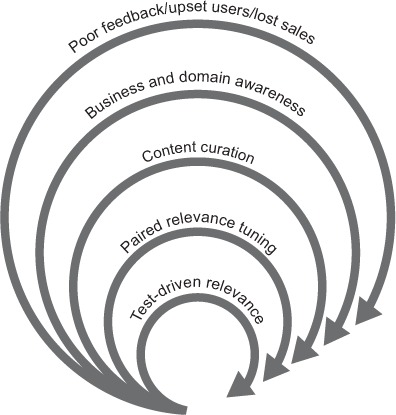
Rooted in these forms of collaboration is the notion of feedback. An effective organization strives to bring relevance engineers accurate and quick feedback to inform and guide their efforts. You can visualize several important feedback loops as a series of increasingly focused circles, as shown in Figure 1.5. Starting on the outermost loop, the search developers operate within an organization, blissfully unaware of the impact of search relevance. As the organization evolves, it moves to inner, more mature forms of feedback: incorporating user behavioral data and expert feedback. Finally, the organization encodes its wisdom into relevance tests, enabling test-driven relevancy practice—the most mature organizational form.
This book primarily teaches you about the technical craft of relevance engineers. But reflecting on what you should be doing hopefully echoes in your mind as you learn these technical lessons. In many examples, we state unequivocally that a particular search result is what users want to see. We do this to teach you technical skills to manipulate the search to get those results. As you work through those examples, remember the examples in this section before applying lessons directly to your relevance problems. We’ll dive deeper into organizational challenges in chapter 10.
How will you get there? Relevant Search teaches you the skills of a relevance engineer. A relevance engineer transforms the search engine into a seemingly smart system that understands the needs of users and the business. To do this, you’ll teach the search engine your content’s important features: attributes such as a restaurant’s location, the words in a book’s text, or the color of a dress shirt. With the right features in place, you can measure what matters to your users when they search: How far is the restaurant from me? Is this book about the topic I need help with? Will this shirt match the pants I just bought? These search-time ranking factors that measure what users care about are called signals. The ever-present challenge, you’ll see, is selecting features and implementing signals that map to the needs of your users and business.
But technical wizardry is only part of the job (as shown in figure 1.1). Understanding what to implement can be more important than how to do so. Ironically, the relevance engineer rarely knows what “relevant” means for a given application. Instead, others—usually nontechnical colleagues—understand the content, business, and users’ goals. You’ll learn to advocate for a relevance-centered enterprise that uses this broader business expertise as well as user behavioral data to reveal the experience that users need from search.
