concept database in category esb

This is an excerpt from Manning's book Open-Source ESBs in Action: Example Implementations in Mule and ServiceMix.
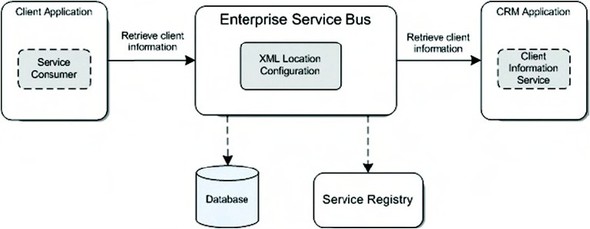
You can implement the location transparency within the ESB with a simple XML configuration, a database, or a service registry. Your approach depends on your requirements, such as dynamic configuration capabilities and the need for additional information about service providers (e.g., quality of service). The simplest implementation of location transparency is the configuration of service provider endpoints in a static XML file. This is a common way to implement location transparency in an open source ESB. When you need dynamic configuration of service provider locations, you require more advanced configuration options. Dynamic configuration can be implemented with a hot-deployment model for location configuration files or with locations stored in a database. When you have even more requirements, such as the definition of quality of service and business information about a specific service provider, a service registry can provide the necessary capabilities. In this book, we focus on the static XML file and the hot-deployment options. Figure 1.7 shows a graphical overview of the options you have available when implementing location transparency with an ESB.
Java Database Connectivity (JDBC)— In many integration scenarios, you need to either store or retrieve information from a database. For instance, storing logging information or retrieving data for message enhancement requires database connectivity. JDBC is the standard Java technology used to connect and query against relational databases. Since we don’t want to install a complete MySQL, PostgreSQL, or other database server, we included HSQLDB in the book’s source code. HSQLDB is a relational database management system written in Java, which requires no additional installation.
Next, we show you how to use the open source ESBs to read from and write to a relational database. We introduce two types of examples, one that queries data from the database and another that manipulates data in the database. We use the HSQL database to implement the examples, because it requires no installation and yet still provides full relational capabilities. Before we delve deeper into these examples, let’s take a quick look at the database table we use to query and store data:
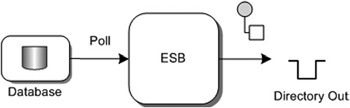
Figure 6.5. Use the ESBs to read a record from the database and write the contents as a file to a directory.
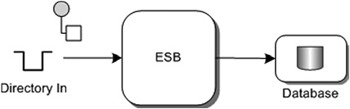
The second example, shown in figure 6.6, is the reverse functionality of the first. This time we read a file from the file system, process the contents from the file, and store the file contents as a new record in the database.