concept JBI component in category esb

This is an excerpt from Manning's book Open-Source ESBs in Action: Example Implementations in Mule and ServiceMix.
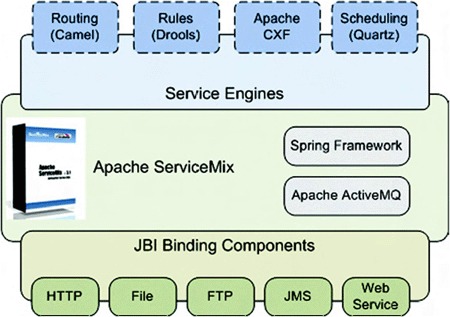
The foundation for Apache ServiceMix is the JBI specification delivered by the Java Community Process (JCP) under Java Specification Request (JSR) 208 in 2005. The purpose of JBI is to define a standard for an integration platform that consists of components from multiple vendors and open source projects (in order to prevent vendor lock-in). For integration products adhering to the JBI specification, it should be possible to build JBI components that can be deployed on all these JBI-based products. A salient detail of the JSR 208 vote was that IBM and BEA abstained, and even today these companies have no integration product adhering to the JBI specification. For more details about the JBI specification, see chapter 2, where we discuss the architecture of ServiceMix. Figure 1.15 gives an overview of the functionality provided by ServiceMix.
After the JBI specification was accepted by the JCP, in late 2005 the Apache ServiceMix project was introduced as an incubator project at Apache. The goal of ServiceMix is to provide an ESB that implements the JBI specification, with a focus on flexibility, reliability, and breadth of connectivity. ServiceMix includes a large set of JBI components that together supply the ESB core functionalities listed in section 1.2. Included are JBI components that support protocols like JMS, HTTP, and FTP, as well as components that implement Hohpe’s patterns of enterprise integration, rules, and scheduling.
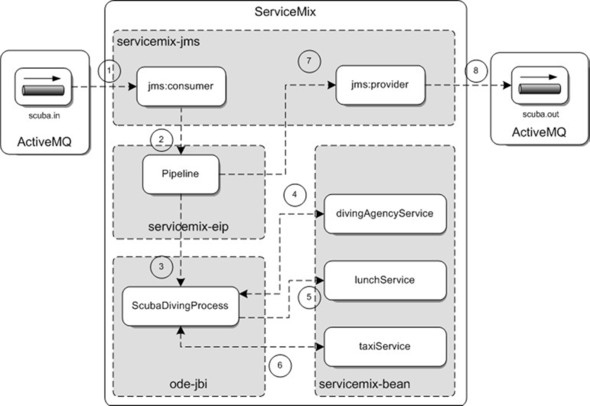
The scuba diving process needs an in-out message exchange, because it sends a reply back to the requesting service. You need to add a pipeline that converts the JMS consumer’s InOnly message exchange into an in-out message exchange for the BPEL process. The last thing you have to decide is how to provide connectivity to the diving agency, lunch service, and taxi service Spring beans. You defined JiBX mappings in section 11.3, so the easiest way to communicate with the Spring beans is to use the Bean Service Engine. Another option would be to use the JSR181 Service Engine, but this component uses its own marshaling and unmarshaling implementation; you use the ServiceMix Bean component for this example. Figure 11.20 provides an overview of the JBI components for the scuba diving process case study.