concept operation in category esb

This is an excerpt from Manning's book Open-Source ESBs in Action: Example Implementations in Mule and ServiceMix.
We’ve already talked about consumers and providers. A provider provides a certain service, and a consumer can consume that service. But how can the consumer tell what kind of operations you can invoke on a certain provider, what do the messages look like that need to be sent, and what kind of errors can you expect? There are two possible sources to get more details about the interface of a service provider. The first one is the obvious one: just look closely at the documentation and determine which operation is provided and what kind of messages can be sent. There is, however, also a more dynamic way of doing this: self-describing services.
Configure the operations in a WSDL file— The insert and polling operations are configured in a WSDL file. In this step we show you how to configure these operations.
The WSDL message section specifies the input and output messages for the operation part of the WSDL definition. The messages defined in this listing
,
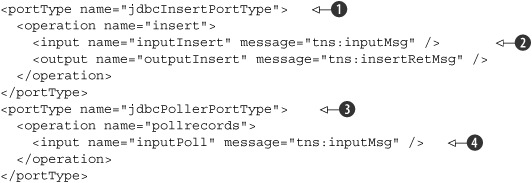
are used in listing 6.21 to define the operations for the JDBC service.
We defined two interfaces, each with one operation. In the poller operation definition
, you might expect an output element instead of the input element inputPoll
, because when you poll a database you get a result. That’s true, but keep in mind that the poller is a service that sends messages to the normalized message router. It reads data from a database and sends that data to a JBI service running in ServiceMix. The operation shown here specifies how the receiving service looks. So a receiving service must be able to handle the operation specified here.