concept scuba diving in category esb

This is an excerpt from Manning's book Open-Source ESBs in Action: Example Implementations in Mule and ServiceMix.
Note that this example is oversimplified and doesn’t show the distinction in functionality between a process engine and an ESB as in figure 11.1. But imagine that the message channels are part of the ESB environment and may be enriched with transformations, routing, and message logging. This should give you a thorough overview of the functionality of the Process Manager pattern, so now let’s look at a case study to implement a process engine. Let’s go scuba diving!
A stay in Hawaii’s SleepingBeauty hotel is an excellent opportunity to go scuba diving for a day. Hawaii provides a wide variety of scuba diving trips that include sharks, dolphins, wrecks, and caves. Currently, the hotel distributes flyers to guests, promoting the idea of booking a scuba diving day trip. This approach seems to be working well, because in the last few months the number of bookings has doubled. But there is one downside: The amount of time the hotel receptionist spends booking trips for hotel guests has also doubled.
After your stay in Hawaii—which of course included a day of scuba diving—you present your solution design to your manager, John, and hotel manager, Gregor, as shown in figure 11.4.
Figure 11.4. The high-level design of the process to book a scuba diving trip, which automates most communication with the involved parties. The hotel receptionist remains responsible for communicating with the hotel guest.
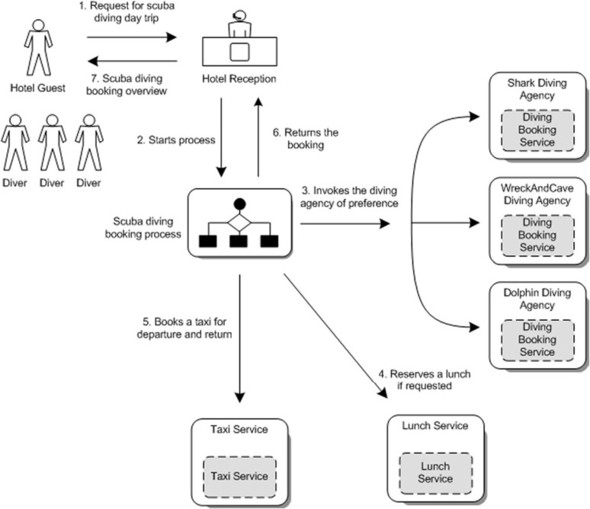
The high-level design shown in figure 11.4 introduces a booking process definition that defines the orchestration of the scuba diving, lunch, and taxi services. The diagram doesn’t yet include the ESB, which takes care of the logic to invoke the services.