concept transformer in category esb

This is an excerpt from Manning's book Open-Source ESBs in Action: Example Implementations in Mule and ServiceMix.
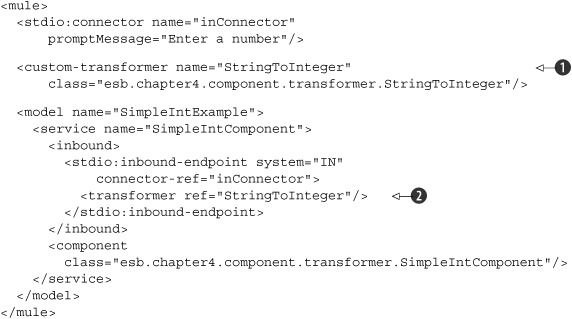
With message routing we saw that XPath is an important open standard for implementing routing rules and that XML Schema is an often used open standard for implementing message validation. To include a message transformation step in your integration solution, the XSLT open standard is a common choice. The assumption is that the messages exchanged via the ESB are in XML format. With ServiceMix you’re forced to XML, although you can build transformers to, for example, change a text-based message to an XML format. But the message format inside ServiceMix is, according to the JBI specification, XML. For Mule there is no need to use XML messages inside the bus. We already saw in previous chapters that you can also exchange POJOs over the Mule bus, but the industry is more and more standardizing on XML for exchanging messages because it’s technology and platform independent. So for the topic of message transformation, we’ll assume that the message format is XML.
Table 5.2. Mapping of JMS messages to Java objects
JMS message type
Java object
javax.jms.TextMessage java.lang.String javax.jms.ObjectMessage java.lang.Object javax.jms.BytesMessage Byte[] (Note that the transformer will check whether the payload is compressed and automatically uncompress the message.) javax.jms.MapMessage java.util.Map javax.jms.StreamMessage java.util.Vector of objects from the stream message