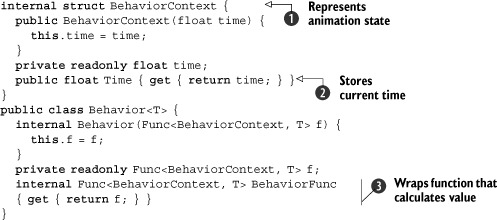
concept behavior in category f#

This is an excerpt from Manning's book F# Deep Dives.
Agent-based model —The behavior of true concurrent systems is different. It’s also called agent-based, because the system consists of multiple agents that can communicate by exchanging messages. The system can be structured as agents that solve individual aspects of the problem, like communicating with a stock exchange, handling user-interface requests, or keeping track of some state.
DSLs bring a number of benefits. Internal DSLs consist of types and functions that map closely to the business domain, and logic can be changed quickly as requirements change. External DSLs can be used to specify behavior or to configure the system. You can achieve properties similar to scripting in video games—you can change the configuration or behavior without recompiling (or even restarting) the application.
This is an excerpt from Manning's book Real-World Functional Programming with Examples in F# and C#.
In functional programming, most of the data structures are immutable, which means that we can’t modify them. Once the Ellipse or Rectangle is created, we can’t change it. The only thing we can do is create a new Ellipse with a new bounding box. This makes it easy to understand what a program does. As listing 1.2 shows, we could rewrite the previous snippet if Ellipse and Rectangle were immutable. As you’ll see, understanding the program’s behavior becomes much easier.
In this section, we talked about object-oriented patterns and related functional techniques. In some cases, we used a function instead of an interface with a single method. Next we’ll look at an example showing what we can do when the behavior is very simple but can’t be described by only one function.