concept server in category gwt

This is an excerpt from Manning's book GWT in Action.
Gmail developers didn’t invent anything new; they used what was already available. In Gmail the development team made use of what’s now referred to as XHR or XMLHttpRequest. XHR is an API created by Microsoft that allows JavaScript to run in the browser to initiate direct communication with the server. Gmail was designed to use this tool, which was available in all major browsers, to change the paradigm of how we interact with websites in a visual and forceful way.
GWT provides several ways for your data to communicate between the client and server. In chapter 7 we explored GWT-RPC, which as you saw is a great general-purpose tool that allows you to transport a Java object between client and server. In this chapter we move to a relative of GWT-RPC named RequestFactory. And this raises the question, how is RequestFactory different than GWT-RPC?
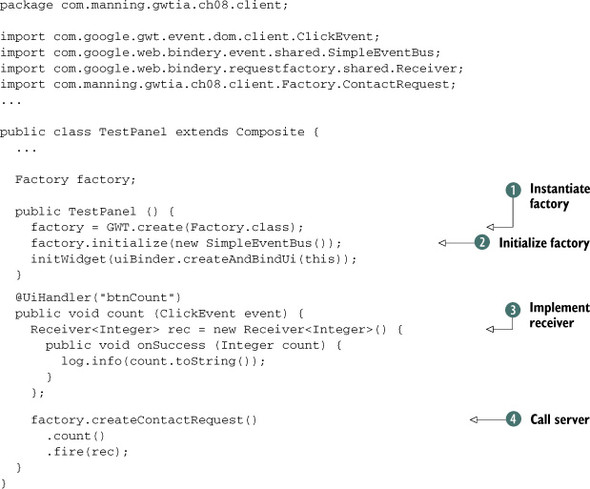
As noted before, our downloadable example provides a TestPanel that’s laid out with the use of UiBinder and contains buttons to trigger commands to be sent to the server. In listing 8.6 we provide you part of this class, which includes the constructor that will initialize the RequestFactory, along with our first button handler.

This is an excerpt from Manning's book GWT in Practice.
To help deal with these problems, a number of toolkits and libraries have emerged. Libraries like Dojo, Script.aculo.us, Ext JS, and the Yahoo User Interface Library (YUI) have sought to provide enhanced core features and general ease of use to JavaScript. In addition, projects like Direct Web Remoting (DWR) have sought to simplify communications between the client and the server. Even more advanced techniques, like those used by XML11 and Echo2, create an entire rendering layer in the browser while executing application code on the server side. These are all valid approaches, but the Google Web Toolkit (GWT) represents something different.
While GWT’s RPC mechanism, which we introduced in chapter 3, is great for greenfield development and can be used to proxy to other service implementations, sometimes it’s more valuable to have your application talk directly to an external service. For instance, if you have existing SOAP-based services that are not colocated with your web application, a two-stage proxy from the web application server can hinder performance and drive up bandwidth costs. Other times you might want to talk to public web services from Amazon, Google, Yahoo, or others. In this chapter we’ll address issues surrounding talking to servers. We’ll start with the security concerns and then look at several technologies—GWT and non-GWT—that enable data transmission and server communication.