concept server side in category gwt

This is an excerpt from Manning's book GWT in Action.
If you already have Java installed, you should verify that you have the JDK installed. This differs from the Java Runtime Environment (JRE) in that it includes tools for compiling Java code. This isn’t strictly needed for compiling GWT applications because the GWT compiler will handle that, but it will be required if you plan on using Java on the server side of RPC calls, which we discuss in chapter 7.
With an understanding of the method we want to execute, we then look at how we can make the method’s input and output types compatible with GWT serialization. Once this is complete, we’ll implement the server side of the equation followed by the client and then follow up with how to add some cross-site request forgery (XSRF) protection to your RPC calls.
In section 7.4 we defined a GWT-compatible model for our GTwitter client. Now we want to look at coding the server side of the equation and deploying it to a servlet container.
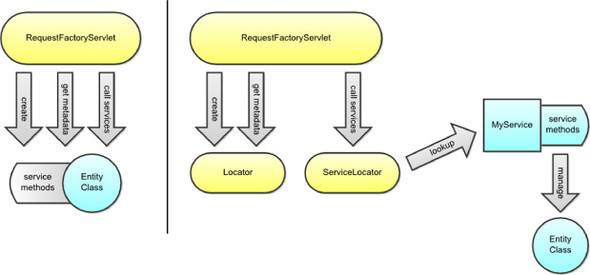

This is an excerpt from Manning's book GWT in Practice.
As the world of web applications began to expand, developers supporting the basic form applications on the server side repurposed the Model View Controller (MVC) pattern so that it centered on the server and rendered to HTML. From simple Perl scripts to complete frameworks, development remained on the server, and things like application state became a complex problem with complex solutions���involving everything from Struts to JavaServer Faces (JSF) and Seam. Although these solutions made web applications more capable and development easier, they didn���t provide the user experience of a full desktop-like fat client application, and they continued in the same render-call-render lifecycle that the web had used when forms were first added.
When Netscape introduced JavaScript to the web browser, the browser became something more than just a simple thin client. It became a platform on its own, capable of running small applications entirely within the scope of a page. This approach was widely used for simple things, such as field validation, but its use didn���t spread to more advanced functionality until Microsoft introduced the XMLHttpRequest (XHR) object. This object made calls back to the server from the JavaScript environment easy, and the technique was soon adopted by all the major browsers. The frontiers and capabilities of web applications expanded even further when dynamic HTML and forms were combined with the server side via XHR, permitting only portions of browser windows to be redrawn. The Ajax era was born.