concept service interface in category gwt

This is an excerpt from Manning's book GWT in Action.
The parts that you’ll need to write include your server-side business logic, the service interface, and potentially custom data objects that will hold the data that’s passed between the client and server. The provided parts include everything else, namely the code that glues the client and the server together. Much of this glue code is generated at compile time and is unseen by the developer.
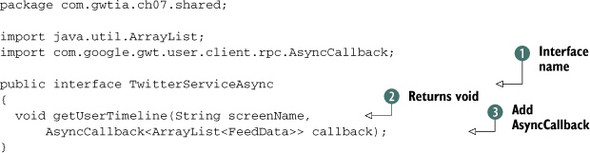
The asynchronous interface is the interface that the client side is coded to. It’s a mirror image of the service interface you already defined, assuming that the mirror you use is one of those funhouse mirrors. Specifically, it’s an altered version of the service interface, altered in a specific way. The next listing contains the code for this interface.
This looks a lot like the service interface, but with two differences. The first is the name of the interface. The asynchronous interface uses the same name as the service interface plus Async
. So the TwitterService service interface will have a TwitterServiceAsync asynchronous interface. This interface must also reside in the same package as the service interface.
Although creating the service interface isn’t as complicated as dealing with GWT-compatible DTOs, you still have a few GWT specifics you need to deal with.