concept MARC record in category haskell

This is an excerpt from Manning's book Get Programming with Haskell.
In a time when data science is a hot trend, it would be great to make some fun projects with all this data. But there’s a big challenge to using this data. Libraries store their book-related metadata in a rather obscure format called a MARC record (for Machine-Readable Cataloging record). This makes using library data much more challenging than if it were in a more common format such as JSON or XML. MARC records are in a binary format that also makes heavy use of Unicode to properly store character encodings. To use MARC records, you have to be careful about separating when you’re working with bytes from when you’re working with text. This is a perfect problem to explore all you’ve learned in this unit!
Our goal for this capstone is to take a collection of MARC records and convert it into an HTML document that lists the titles and authors of every book in the collection. This will leave you with a solid foundation to further explore extracting data from MARC records:
Getting the leader from a MARC record is as straightforward as taking the first 24 characters of the MarcRecord.
Listing 26.11. getLeader grabs the first 24 bytes of the record
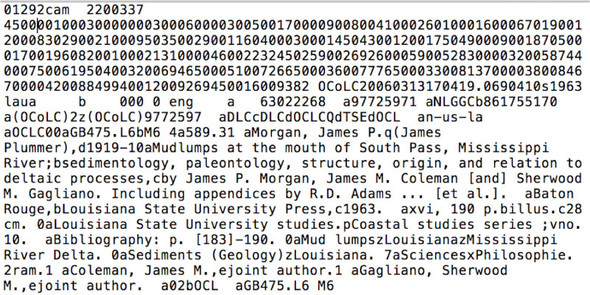
getLeader :: MarcRecordRaw -> MarcLeaderRaw getLeader record = B.take leaderLength recordJust as the first 24 bytes of the MARC record is the leader, the first 5 bytes of the leader contain a number telling you the length of the record. For example, in figure 26.4 you see that the record starts with 01292, which means this record is 1,292 bytes long. To get the length of your entire record, you need to take these first five characters and then convert them to an Int type. You’ll create a useful helper function, rawToInt, which will safely convert your ByteString to Text, then convert that Text to a String, and finally use read to parse an Int.
The MARC record is the standard used in libraries for recording and transmitting information about books (called bibliographic data). If you’re interested in data about books, MARC records are an important format to understand. There are many large, freely available collections of MARC records online. You’ll be using the Oregon Health & Science University library records in this capstone. As noted earlier, MARC stands for Machine-Readable Cataloging record. As indicated by the name, MARC records are designed to be read by machines. Unlike formats such as JSON and XML, they aren’t designed to be human-readable. If you open a MARC record file, you’ll see something that looks like figure 26.2.
If you’ve ever worked with the ID3 tag format for storing MP3 metadata, you’ll find MARC records are similar.