concept condition in category java
This is an excerpt from Manning's book Java SE 11 Programmer I Certification Guide.
Let’s redefine variable, avg, local to the if block of an if statement (code that executes when the if condition evaluates to true):
The statement score = 200; executes if the if condition is true. Although it looks like the statement name = "Larry"; is part of the if statement, it isn’t. It will execute regardless of the result of the if condition because of the lack of braces {}.
for (initialization; condition; update) {
     statements;
}
This is an excerpt from Manning's book OCA Java SE 8 Programmer I Certification Guide.
An expression used in an if condition should evaluate to a boolean value.
The statement score = 200; executes if the if condition is true. Although it looks like the statement name = "Larry"; is part of the if statement, it isn’t. It will execute regardless of the result of the if condition because of the lack of braces {}.
for (initialization; condition; update) {
     statements;
}
An if construct enables you to execute a set of statements in your code based on the result of a condition. This condition must always evaluate to a boolean or a Boolean value. You can specify a set of statements to execute when this condition evaluates to true or false. (In many Java books, the terms constructs and statements are used interchangeably.)
This is an excerpt from Manning's book Functional Programming in Java: How functional techniques improve your Java programs.
It won’t create conditions causing other code to unexpectedly fail. For example, it won’t mutate arguments or some other external data, causing the caller to find itself with stale data or concurrent access exceptions.
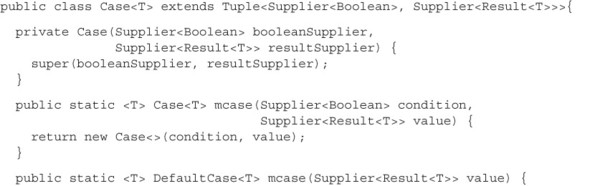
Write a method filter taking a condition that’s represented by a function from T to Boolean, and returning a Result<T>, which will be a Success or a Failure depending on whether the condition holds for the wrapped value. The signature will be
filter(Function<T, Boolean> f);Create a second method taking a condition as its first argument and a String as a second argument, and using the string argument for the potential Failure case.
This is an excerpt from Manning's book JavaFX in Action.
In this chapter we will look at how variables are created and manipulated. JavaFX Script has a lot of interesting features in this area, beyond those offered by languages like Java or JavaScript, such as sophisticated array manipulation and the ability to bind variables into automatic update relationships. By the end of this chapter you’ll understand how these features work, so in the next chapter we can explore how they integrate into standard programming constructs like loops, conditions, and classes.
Conditions are a standard part of all programming languages. Without them we’d have straight line code, doing the same thing every time with zero regard for user input or other runtime stimuli. This would cut dramatically the number of bugs in our code but would ever so slightly render all software completely useless.