concept load balancing in category jboss

This is an excerpt from Manning's book JBoss in Action: Configuring the JBoss Application Server.
Load balancing is a way of balancing incoming load, or concurrent requests, across multiple application server instances, making your applications scalable and highly available. Scalability is a term used to describe the ability to make your application handle more user load by adding hardware and/or creating redundant instances of your application without having to change code. Load balancing can help scale your application because you can add more servers for the load balancer to balance the load across, increasing the amount of traffic your application can handle. High availability is the ability to continue processing requests in the face of server failure. We discuss high availability more in section 12.1.4.
Figure 12.1 shows you the difference between an application with and without load balancing.
Figure 12.1. An application without load balancing (left) provides a single point of failure and a potential bottleneck, but an application with load balancing (right) can scale better and enables high availability.
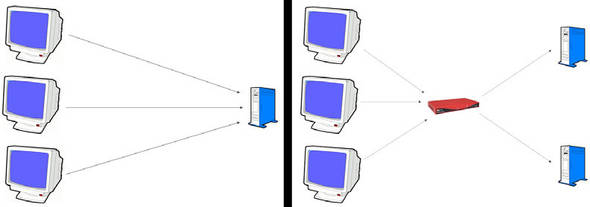
The load balancer acts as a single point of entry into an application environment as well as a traffic director for requests. In the diagram found in figure 12.1, you see that the load balancer (in the middle of the figure on the right) decides which server to send the requests to. Because this decision happens upstream of the application server, in many cases, load balancing isn’t a feature of the application or the application server and doesn’t even require a cluster. Clusters are necessary when nodes need to communicate with each other, but aren’t necessarily required for load balancing.