concept organization in category liferay

This is an excerpt from Manning's book Liferay in Action: The Official Guide to Liferay Portal Development.
Organizations are hierarchical collections of users. Users can be members of one or many of them, up and down the hierarchy. Membership in organizations gives users access to the pages of that organization. If you picture a hierarchical structure that represents a company called Inkwell, some users might belong to Inkwell, Sales Department, Mid-Atlantic Region. This not only denotes the employees’ position in the company, but also gives employees access to the content they need to do their jobs.
If you create this role as a portal role, then any members of the role have the defined permissions across the entire portal, in any community or organization. This allows users in this role to administer wikis in whatever communities or organizations they have access to. But you can define the role in another way, by scoping it only by community or organization. If the role is defined this way, users have the role’s permission in only the community or organization in which that role is assigned. As you can see, scope is important when it comes to how permissions are defined.
Let’s stick with the wiki example. If you place a Wiki portlet on a page, based on what I’ve described, where is that page? Yes, it’s in a community or organization. That wiki now belongs to that community or organization.
You can’t place another Wiki portlet on the same page, because that portlet is what Liferay calls non-instanceable. The portlet’s set of data belongs to that community or organization. This is in contrast to instanceable portlets, where the set of data belongs to the user. But we’ll get to those in a minute.
You can place another Wiki portlet on a different page in that community or organization, but that Wiki portlet will display the same data as the first one (that is, unless you place it in another scope, which we’ll also get to in a minute). Why is that? Because the portlet’s data set has already been created, by placing it on a page in that community or organization. In other words, non-instanceable portlets by default all point to the same instance of data (see figure 1.12).
Figure 1.12. A non-instanceable, scopeable portlet has its data scoped by the community or organization to which it belongs. No matter how many times you add it to the community or organization, it points to the same data.
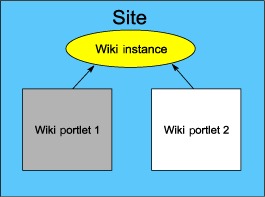
For non-instanceable portlets, the data a portlet contains belongs to the community or organization.