concept machine in category machine learning

This is an excerpt from Manning's book Grokking Machine Learning.
With this in mind, I embarked in a journey for understanding the melody of machine learning. I stared at formulas and code for months, drew many diagrams, scribbled drawings on napkins with my family, friends, and colleagues, trained models on small and large datasets, experimented, until finally some very pretty mental pictures started appearing. But it doesn’t have to be that hard for you. You can learn more easily without having to deal with the math from the start. Especially since the increasing sophistication of ML tools removes much of the math burden. My goal with this book is to make machine learning fully understandable to every human, and this book is a step on that journey, that I’m very happy you’re taking with me!

This is an excerpt from Manning's book Human-in-the-Loop Machine Learning.
I am hopeful that readers of this book will become excited about annotation as a science, and readers will appreciate that it goes far beyond creating quality training data to more sophisticated problems that we are trying to solve when humans and machines work together.
Continuous tasks lend themselves well to machine learning-driven quality control. You can apply most of the machine learning techniques from quality control for labeling tasks earlier in this chapter, but instead of predicting the labels your machine learning model can use regression to predict a continuous value.
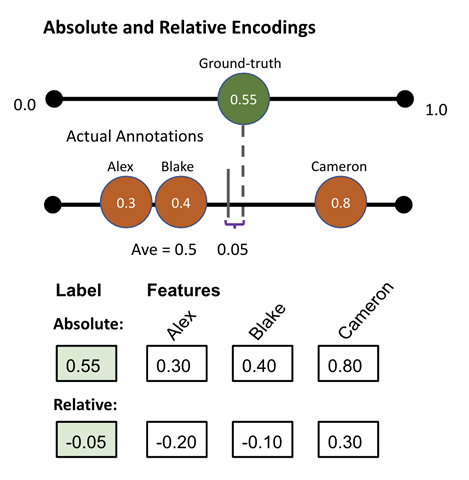
Figure ABSOLUTE_RELATIVE A comparison of absolute and relative encodings when using machine learning to predict the correct number from the annotations. Here, Alex, Blake, and Cameron have annotated 0.3, 0.4, and 0.8 for a ground-truth item where the actual value was 0.55. We can encode the absolute values of the annotations with the ground-truth as the label (target value) for this training data item. Alternatively, we can take the average of the annotators, which is 0.5, and encode the fact that this should be 0.05 higher. We similarly encode each annotation by how much it differs from the ground truth. Another way to think of the relative encoding is that it is encoding the error of our average, instead of the values.
This is an excerpt from Manning's book Machine Learning Bookcamp.
To use machine learning to solve real-life problems, we need a way to organize machine learning projects. In this chapter we talk about CRISP-DM: a step-by-step methodology for implementing successful machine learning projects.
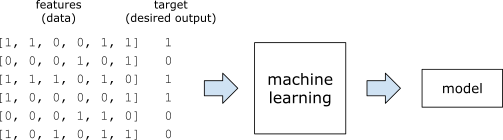
Figure 1.7 The input to a machine learning algorithm consists of multiple feature vectors and the target variable for each vector.

This is an excerpt from Manning's book Exploring Machine Learning Basics.
With this in mind, I embarked in a journey for understanding the melody of machine learning. I stared at formulas and code for months, drew many diagrams, scribbled drawings on napkins with my family, friends, and colleagues, trained models on small and large datasets, experimented, until finally some very pretty mental pictures started appearing. But it doesn’t have to be that hard for you. You can learn more easily without having to deal with the math from the start. Especially since the increasing sophistication of ML tools removes much of the math burden. My goal with this book is to make machine learning fully understandable to every human, and this book is a step on that journey, that I’m very happy you’re taking with me!
The reason automation is hard to implement is because, even though these processes look repetitive, there are small decisions that need to be made at several steps along the way. This is where machine learning fits in. You can use machine learning to make these decisions at each point in the process in much the same way a human currently does.
As you read through other resources on machine learning, you will see that machine learning can cover many other things. But most of these things can be broken down into a series of decisions. Take machine learning systems for autonomous cars, for example. On the face of it, this sounds very different from the machine learning we are looking at. But it is really just a series of decisions. One machine learning algorithm looks at a scene and decides how to draw boxes around each of the objects in the scene. Another machine learning algorithm decides whether these boxes are things that need to be driven around. And, if so, a third algorithm decides the best way to drive around them.
To determine whether you can use machine learning to help out Karen, let’s look at the decisions made in Karen’s process. When an order comes in, Karen needs to decide whether to send it straight to the requester’s financial approver or whether she should send it to a technical approver first. She needs to send an order to a technical approver if the order is for a technical product like a computer or a laptop. She does not need to send it to a technical approver if it is not a technical product. And she does not need to send the order for technical approval if the requester is from the IT department. Let’s assess whether Karen’s example is suitable for machine learning.

This is an excerpt from Manning's book How Machine Learning Works.
The last major type of machine learning problems, which will be outside the scope of this book but we're including here for comprehension, is reinforcement learning. In reinforcement learning we're basically trying to learn how to survive in an environment. Think of a self-driving car. The car needs to be able to survive on the streets without having or causing any accidents. This kind of machine learns how to drive first by going through a simulation of the streets. It starts taking actions and observes what happens and how the environment reacts. If an accident happened, the action that the car took is punished and discouraged in the future. On the other hand, if everything went fine, that action is rewarded and encouraged to done in similar situations. By repeatedly interacting with environment and reinforcing the rewarded actions, the agent finally learns how to survive in that environment. Although this type of problems is outside the scope of the book, everything that we'll learn here will be fundamental in doing reinforcement learning; this is true because deep down, reinforcement learning shares the same mathematical foundation as the other two types, but is a little more complicated due to the existence of an external environment.
This here is a mathematical justification for why machines can learn from data, which agrees with the intuition we had all along; the more data we have to train our model on, the gap between the training error and the test error will become small, we’ll call that gap the generalization gap from now on. So if we managed to get our training error to a small value, our test error will be small provided that we have sufficient data. While this is a concrete and rigorous justification for why we can learn models from data, it still lacks an several points, like how many data is considered sufficient, and how does the model’s size and variance plays a role in that. This motivates the need to take a closer look at what the value of the probability above looks like.

This is an excerpt from Manning's book Machine Learning with R, the tidyverse, and mlr.
In statistics, when the data is formatted like this, each row is said to correspond to one subject in the data, with a subject here being a single hippo. In data science and machine learning, it’s more common to see the term case to describe a single unit in the data, so this is the term I use throughout the book.
So, having gathered data on your patients, you train a machine learning algorithm to learn patterns in the data associated with the patients’ survival. Now, when you gather data on a new patient, the algorithm can estimate the risk of that patient dying.
The problem with this approach is that we need to know in advance all the possible outputs the computer should give, and the system will never give us an output that we haven’t told it to give. Contrast this with the machine learning approach, where instead of telling the computer the rules, we give it the data and allow it to learn the rules for itself. The advantage of this approach is that the machine can “learn” patterns we didn’t even know existed in the data—and the more data we provide, the better it gets at learning those patterns (figure 1.2).
Figure 1.2. Traditional AI vs. machine learning AI. In traditional AI applications, we provide the computer with a complete set of rules. When it’s given data, it outputs the relevant answers. In machine learning, we provide the computer with data and the answers, and it learns the rules for itself. When we pass new data through these rules, we get answers for this new data.


This is an excerpt from Manning's book Machine Learning for Business: Using Amazon SageMaker and Jupyter.
The reason automation is hard to implement is because, even though these processes look repetitive, there are small decisions that need to be made at several steps along the way. This is where machine learning fits in. You can use machine learning to make these decisions at each point in the process in much the same way a human currently does.
As you read through other resources on machine learning, you will see that machine learning can cover many other things. But most of these things can be broken down into a series of decisions. Take machine learning systems for autonomous cars, for example. On the face of it, this sounds very different from the machine learning we are looking at. But it is really just a series of decisions. One machine learning algorithm looks at a scene and decides how to draw boxes around each of the objects in the scene. Another machine learning algorithm decides whether these boxes are things that need to be driven around. And, if so, a third algorithm decides the best way to drive around them.
To determine whether you can use machine learning to help out Karen, let’s look at the decisions made in Karen’s process. When an order comes in, Karen needs to decide whether to send it straight to the requester’s financial approver or whether she should send it to a technical approver first. She needs to send an order to a technical approver if the order is for a technical product like a computer or a laptop. She does not need to send it to a technical approver if it is not a technical product. And she does not need to send the order for technical approval if the requester is from the IT department. Let’s assess whether Karen’s example is suitable for machine learning.

This is an excerpt from Manning's book Real-World Machine Learning.
The aim of this book isn’t to describe the gory mathematical details of machine-learning algorithms (although we’ll peel back a few layers of the onion to provide insight into the inner workings of the most common ones). Rather, the book’s primary purpose is to instruct non-experts on important aspects and common challenges when integrating machine learning into real-world applications and data pipelines. In this first chapter, we present a real business problem—reviewing loan applications—to demonstrate the advantages of using machine learning over some of the most common alternatives.
These strategies are embodied in collections of algorithms developed over the course of recent decades by academics and practitioners in disciplines ranging from statistics, computer science, robotics, and applied mathematics, to online search, entertainment, digital advertising, and language translation. They are diverse and have various strengths and weaknesses. Some of them are classifiers. Others predict a numeric measurement. Some measure the similarity or difference of comparable entities (for example, people, machines, processes, cats, dogs). What the algorithms have in common is learning from examples (experience) and the capacity to apply what they’ve learned to new, unseen cases—the ability to generalize.