concept metadata in category machine learning
This is an excerpt from Manning's book Introducing Data Science: Big data, machine learning, and more, using Python tools.
Finding data even within your own company can sometimes be a challenge. As companies grow, their data becomes scattered around many places. Knowledge of the data may be dispersed as people change positions and leave the company. Documentation and metadata aren’t always the top priority of a delivery manager, so it’s possible you’ll need to develop some Sherlock Holmes–like skills to find all the lost bits.
1. Create and register metadata.

This is an excerpt from Manning's book Collective Intelligence in Action.
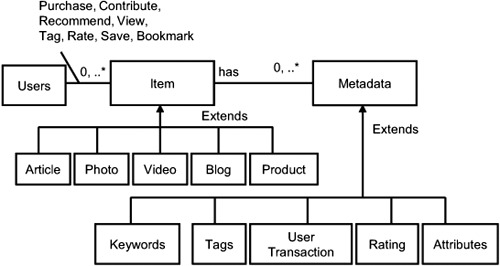
Associated with each item is metadata, which may be in the form of professionally developed keywords, user-generated tags, keywords extracted by an algorithm after analyzing the text, ratings, popularity ranking, or just about anything that provides a higher level of information about the item and can be used to correlate items together. Think about metadata as a set of attributes that help qualify an item.
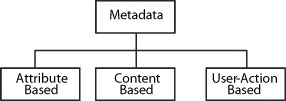
When an item is a user, in most applications there’s no content associated with a user (unless your application has a text-based descriptive profile of the user). In this case, metadata for a user will consist of profile-based data and user-action based data. Figure 2.5 shows the three main sources of developing metadata for an item (remember a user is also an item). We look at these three sources next.
As shown in figure 3.7, you can combine the tag’s context with the user’s metadata as a query to the search engine to get relevant results for the user.
Figure 3.7. Using a tag, the context that it appears in, and user metadata to get relevant results from a search engine
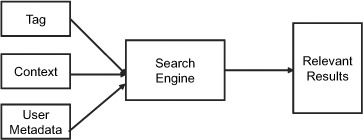
An example illustrates this approach well. Let’s say that a tag Spring appears in a tag cloud that’s used for navigating books in the application. Further, the user’s profile identifies her as a developer. Here, the context of the query is books, while the metadata associated with the user is from her profile—developer. Relevant results can be shown to the user when she clicks on the tag Spring by making the following query to the search engine: Books Spring Developer.
Tags provide a common vocabulary to represent metadata associated with users and items. The metadata developed can be again divided into content-based metadata and collaborative-based metadata.
In the content-based approach, metadata associated with the item is developed by analyzing the item’s content as explained in section 2.2.3. This is represented by a term vector, a set of tags with their relative weights. Similarly, metadata can be associated with the user by aggregating the metadata of all the items visited by the user within a window of time, as explained in section 2.4.2.
In the collaborative approach, user actions are used for deriving metadata. User tagging is an example of such an approach, and we illustrated with the example in section 2.2. Basically, the metadata associated with the item can be computed by computing the term vector from the tags—taking the relative frequency of the tags associated with the item and normalizing the counts.
When you think about metadata for a user and item using tags, think about a term vector with tags and their related weights.