concept operation in category machine learning
This is an excerpt from Manning's book Machine Learning Bookcamp.
Elementwise operations in NumPy and Pandas are quite convenient. We can apply an operation to an entire NumPy array (or a Pandas series) without writing loops.
Such element-wise operations are often called vectorized: the for loop happens internally in native code (written C and fortran), so the operations are very fast!
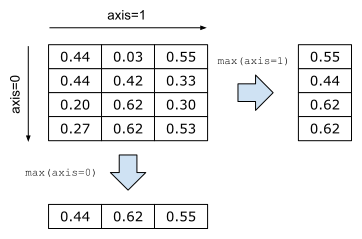
Figure C.10 We can specify the axis along which we apply the operation: “axis=1” means applying it rows and “axis=0” means applying it to columns.
This is an excerpt from Manning's book Introducing Data Science: Big data, machine learning, and more, using Python tools.
No clear one-to-one mapping exists between the problems and solutions because many solutions address both lack of memory and computational performance. For instance, data set compression will help you solve memory issues because the data set becomes smaller. But this also affects computation speed with a shift from the slow hard disk to the fast CPU. Contrary to RAM (random access memory), the hard disc will store everything even after the power goes down, but writing to disc costs more time than changing information in the fleeting RAM. When constantly changing the information, RAM is thus preferable over the (more durable) hard disc. With an unpacked data set, numerous read and write operations (I/O) are occurring, but the CPU remains largely idle, whereas with the compressed data set the CPU gets its fair share of the workload. Keep this in mind while we explore a few solutions.
