concept subset in category machine learning
This is an excerpt from Manning's book Machine Learning with TensorFlow, Second Edition.
The first step in applying the Bag of Words model to processing this review is to preprocess the text and extract only the words with actual meaning. This usually means that you remove any non-letter character such as numbers or additional annotations, including HTML tags, or apostrophes, and generally strip the text down to its bare words. After that, the approach reduces the remaining words in the subset to those that are nouns or verbs or adjectives, and takes out articles, conjunctions, and other stop-words or words that are not distinguishing features of the text itself.
Focusing on the good news: I’ve got a dataset that you can use to perform facial identification and to build your own version of VGG Face, which I’ll call VGG Face Lite. It’s a subset that with four celebrities that will run on your computer and illustrate the architecture and the overall point for training. Then I’ll show you how to use the full model to make predictions using TensorFlow’s Estimator API.

This is an excerpt from Manning's book Real-World Machine Learning.
You’re now in a position to begin looking for trends between the applicant data and incidence of loan repayment. In particular, you perform a manual search for a set of filtering rules that produces a subset of “good” loans that were primarily paid on time. Through the process of manually analyzing hundreds of applications, you’ve gained extensive experience about what makes each application good or bad.[4] Through some introspection and back-testing of loan repayment status, you’ve noticed a few trends in the credit background checks data:[5]
We further discuss feature selection algorithms in chapter 5. These approaches seek the most accurate model built on a subset of the feature set; they retain the signal in the feature set while discarding the noise. Though computationally expensive, they can yield a tremendous boost in model performance.
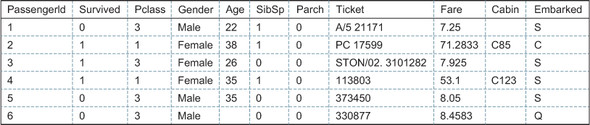
Listing 4.1. Cross-validation with the holdout method
# assume that we begin with two inputs: # features – a matrix of input features # target – an array of target variables corresponding to those features features = rand(100,5) target = rand(100) > 0.5 N = features.shape[0] # The total number of instances N_train = floor(0.7 * N) # The total number of training instances idx = random.permutation(N) #1 idx_train = idx[:N_train] #2 idx_test = idx[N_train:] #2 features_train = features[idx_train,:] #3 target_train = target[idx_train] #3 features_test = features[idx_test,:] #3 target_test = target[idx_test] #3 # Build, predict, evaluate (to be filled out) # model = train(features_train, target_train) # preds_test = predict(model, features_test) # accuracy = evaluate_acc(preds_test, target_test) #1 - Randomizes index #2 - Splits index #3 - Breaks your data into training and testing subsets