concept Cordova in category meteor

This is an excerpt from Manning's book Meteor in Action.
Figure 1.6 shows the anatomy of Meteor applications. Developers define business logic that consists of code, templates and styles, and assets such as image files. Meteor can leverage the power of external packages from the Node.js ecosystem via npm and Cordova for mobile devices. Additionally, it defines its own package format called Isopacks.
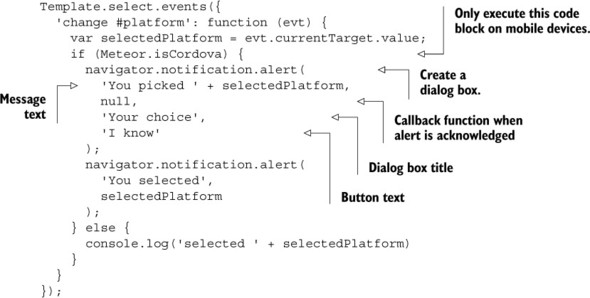
Cordova[7] is a framework that converts HTML, JavaScript, and CSS into a native application that can run on mobile platforms such as iOS or Android. It provides a native wrapper around a web view (think of it as an embedded browser) and offers access to hardware features like the camera or GPS. To a user, apps built on Cordova look and behave exactly like native apps. They’re distributed via app stores, so in order to sell mobile Meteor apps you must be part of Apple’s or Google’s developer program.
7If you want to learn more about Cordova, refer to Raymond K. Camden’s Apache Cordova in Action (Manning, 2015).
Because it’s an Apache project, Cordova is open source and free to use. There’s also PhoneGap, which is often used to describe the same tool. Technically PhoneGap is a distribution of Cordova that’s maintained by Adobe and offers some paid features. For the purpose of putting Meteor applications on mobile devices, we’ll refer only to Cordova from here on, but on Google and Stack Overflow most of the time you can use both terms interchangeably.