concept circuit breaker in category microservice

This is an excerpt from Manning's book Bootstrapping Microservices with Docker, Kubernetes and Terraform.
Chaos Engineering by Mikolaj Pawlikowski To learn more about logging and monitoring in production please read these books:

This is an excerpt from Manning's book Microservices in Action.
Although splitting your application into multiple services can isolate failure, it also will multiply points of failure. In addition, you’ll need to account for what happens when failure does occur to prevent cascades. This involves both design — favoring asynchronous interaction where possible and using circuit breakers and timeouts appropriately — and operations — using provable continuous delivery techniques and robustly monitoring system activity.
You can combine some of the techniques we've discussed so far. You can consider an interaction between holdings and market-data as analogous to an electrical circuit. In electrical wiring, circuit breakers perform a protective role — preventing spikes in current from damaging a wider system. Similarly, a circuit breaker is a pattern for pausing requests made to a failing service to prevent cascading failures.
If the number of failures seen or the rate of failures within a certain time window passes a threshold, then the circuit is opened. Rather than attempting to send requests to your collaborating service, you should short-circuit requests and, where possible, perform an appropriate fallback — returning a stubbed message, routing to a different service, or returning a cached response. Figure 6.15 illustrates the lifecycle of a request using a circuit breaker.
Setting the time window and threshold requires careful consideration of both the expected reliability of the target service and the volume of interactions between services. If requests are relatively sparse, then a circuit breaker may not be effective, because a large time window might be required to obtain a representative sample of requests. For service interactions with contrasting busy and quiet periods, you may want to introduce a minimum throughput to ensure a circuit only reacts when load is statistically significant.
Figure 6.15 A circuit breaker controls the flow of requests between two services and opens when the number of failed requests surpasses a threshold.


This is an excerpt from Manning's book Spring Microservices in Action.
Using the Netflix Hystrix libraries, you can quickly implement service client resiliency patterns such as the circuit breaker and bulkhead patterns.
The circuit breaker pattern is a client resiliency pattern that’s modeled after an electrical circuit breaker. In an electrical system, a circuit breaker will detect if too much current is flowing through the wire. If the circuit breaker detects a problem, it will break the connection with the rest of the electrical system and keep the downstream components from the being fried.
With a software circuit breaker, when a remote service is called, the circuit breaker will monitor the call. If the calls take too long, the circuit breaker will intercede and kill the call. In addition, the circuit breaker will monitor all calls to a remote resource and if enough calls fail, the circuit break implementation will pop, failing fast and preventing future calls to the failing remote resource.
This whole scenario could be avoided if a circuit-breaker pattern had been implemented at each point where a distributed resource had been called (either a call to the database or a call to the service). In figure 5.2, if the call to Service C had been implemented with a circuit breaker, then when service C started performing poorly, the circuit breaker for that specific call to Service C would have been tripped and failed fast without eating up a thread. If Service B had multiple endpoints, only the endpoints that interacted with that specific call to Service C would be impacted. The rest of Service B’s functionality would still be intact and could fulfill user requests.
A circuit breaker acts as a middle man between the application and the remote service. In the previous scenario, a circuit breaker implementation could have protected Applications A, B, and C from completely crashing.
In figure 5.3, the Service B (the client) is never going to directly invoke Service C. Instead, when the call is made, Service B is going to delegate the actual invocation of the service to the circuit breaker, which will take the call and wrap it in a thread (usually managed by a thread pool) that’s independent of the originating caller. By wrapping the call in a thread, the client is no longer directly waiting for the call to complete. Instead, the circuit breaker is monitoring the thread and can kill the call if the thread runs too long.
Figure 5.3. The circuit breaker trips and allows a misbehaving service call to fail quickly and gracefully.
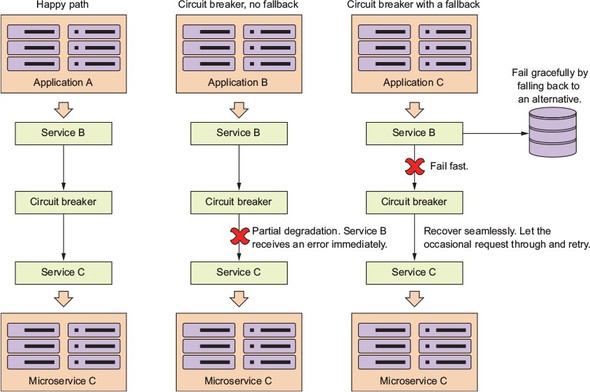
Three scenarios are shown in figure 5.3. In the first scenario, the happy path, the circuit breaker will maintain a timer and if the call to the remote service completes before the timer runs out, everything is good and Service B can continue its work. In the partial degradation scenario, Service B will call Service C through the circuit breaker. This time, though, Service C is running slow and the circuit breaker will kill the connection out to the remote service if it doesn’t complete before the timer on the thread maintained by the circuit breaker times out.
Service B will then get an error from making the call, but Service B won’t have resources (that is, its own thread or connection pools) tied up waiting for Service C to complete. If the call to Service C is timed-out by the circuit breaker, the circuit breaker will start tracking the number of failures that have occurred.
If enough errors on the service have occurred within a certain time period, the circuit breaker will now “trip” the circuit and all calls to Service C will fail without calling Service C.

This is an excerpt from Manning's book Microservices in .NET Core: with examples in Nancy.
Polly is a library that makes it easy to implement one of the more common policies for handling remote-call failures. Out of the box, Polly has support for various retry and circuit breaker policies. I’ll discuss circuit breakers in chapter 6.
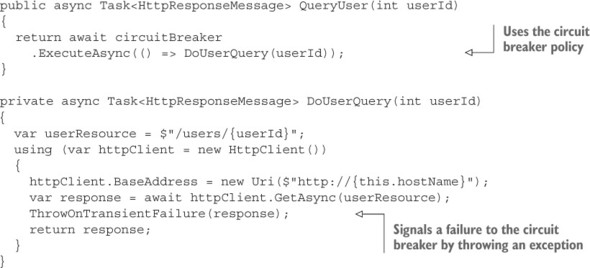
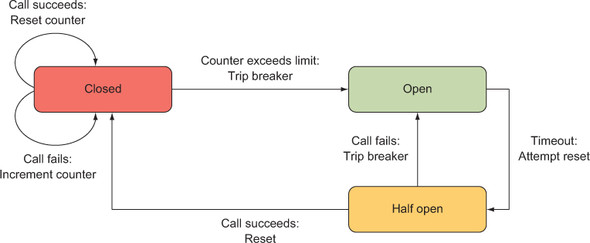
A circuit breaker wraps HTTP requests in a state machine like the one shown in figure 6.9. When the microservice needs to make an HTTP request, it does so through the circuit breaker.
Now you’ll add a circuit breaker to the API Gateway microservice’s queries to the Loyalty Program microservice. This time, you’ll use Polly’s built-in support for circuit breaker policies.