concept HTTP POST in category microservice
appears as: HTTP POST, HTTP POST, n HTTP POST

This is an excerpt from Manning's book Bootstrapping Microservices with Docker, Kubernetes and Terraform.
There are two sides to the messaging equation. One microservice will send a message and another will receive it. In this section, we examine how to send a message using a HTTP POST request.
Listing 9.14 shows how the video upload microservice handles the incoming video. At this point we create a unique ID for the video by creating an instance of MongoDB’s ObjectId class. The request is then forwarded to the video storage microservice.
This is an excerpt from Manning's book Microservices in .NET Core: with examples in Nancy.
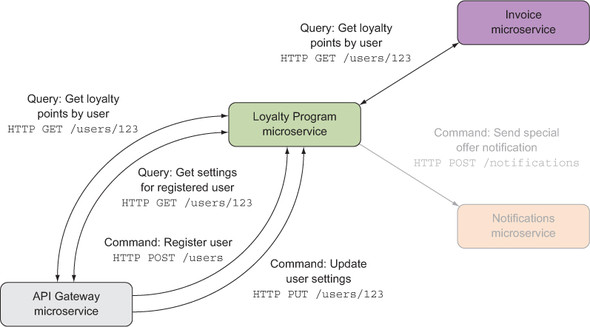
Figure 4.3. The Loyalty Program microservice collaborates with three other microservices using commands and queries. The queries are implemented as HTTP GET requests, and the commands are implemented as HTTP POST or PUT requests. The command collaboration with the Notifications microservice is grayed out because I’m not going to show its implementation—it’s done exactly the same way as the other collaborations.