concept Order in category microservice

This is an excerpt from Manning's book Microservices Security in Action.
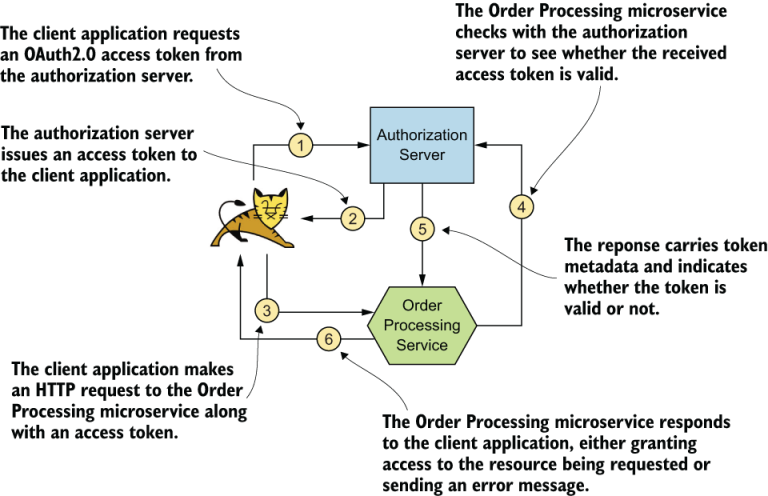
Once a request is inside the application layer, you don’t need to worry about security when one component talks to another. When the Order Processing component talks to the Inventory component, for example, you don’t necessarily need to enforce any additional security checks (but, of course, you can if you need to enforce more granular access-control checks at the component level). These are in-process calls and in most cases are hard for a third party to intercept.
By default, Spring Boot starts the microservice on HTTP port 8080. If you have any other services running on your local machine on port 8080, make sure to stop them; alternatively, you can change the default port of the Order Processing microservice by changing the value of the
server.portproperty as appropriate in the chapter02/sample01/src/main/resources/application.properties file. But, then again, it would be much easier to follow the rest of the samples in the chapter, with minimal changes, if you keep the Order Processing microservice running on the default port.
This is an excerpt from Manning's book Microservices Patterns.
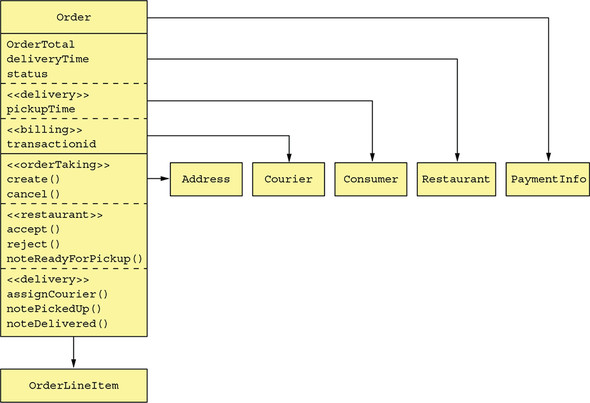
The Order class is a great example of a god class in the FTGO application. That’s not surprising—after all, the purpose of FTGO is to deliver food orders to customers. Most parts of the system involve orders. If the FTGO application had a single domain model, the Order class would be a very large class. It would have state and behavior corresponding to many different parts of the application. Figure 2.10 shows the structure of this class that would be created using traditional modeling techniques.
As you can see, the Order class has fields and methods corresponding to order processing, restaurant order management, delivery, and payments. This class also has a complex state model, due to the fact that one model has to describe state transitions from disparate parts of the application. In its current form, this class makes it extremely difficult to split code into services.
One solution is to package the Order class into a library and create a central Order database. All services that process orders use this library and access the access database. The trouble with this approach is that it violates one of the key principles of the microservice architecture and results in undesirable, tight coupling. For example, any change to the Order schema requires the teams to update their code in lockstep.
Another solution is to encapsulate the Order database in an Order Service, which is invoked by the other services to retrieve and update orders. The problem with that design is that the Order Service would be a data service with an anemic domain model containing little or no business logic. Neither of these options is appealing, but fortunately, DDD provides a solution.
A much better approach is to apply DDD and treat each service as a separate subdomain with its own domain model. This means that each of the services in the FTGO application that has anything to do with orders has its own domain model with its version of the Order class. A great example of the benefit of multiple domain models is the Delivery Service. Its view of an Order, shown in figure 2.11, is extremely simple: pickup address, pickup time, delivery address, and delivery time. Moreover, rather than call it an Order, the Delivery Service uses the more appropriate name of Delivery.
Listing 5.14. The Order class and its fields
@Entity
@Table(name="orders")
@Access(AccessType.FIELD)
public class Order {

  @Id
  @GeneratedValue
  private Long id;

  @Version
  private Long version;

  private OrderState state;
  private Long consumerId;
  private Long restaurantId;

  @Embedded
  private OrderLineItems orderLineItems;

  @Embedded
  private DeliveryInformation deliveryInformation;

  @Embedded
  private PaymentInformation paymentInformation;

  @Embedded
  private Money orderMinimum;
The integration glue code isn’t a standalone component. Instead, it consists of adapters in the monolith and the service that use one or more interprocess communication mechanisms. For example, integration glue for Delayed Delivery Service, described in section 13.4.1, uses both REST and domain events. The service retrieves customer contract information from the monolith by invoking a REST API. The monolith publishes Order domain events so that Delayed Delivery Service can track the state of Orders and respond to orders that won’t be delivered on time. Section 13.3.1 describes the integration glue code in more detail.
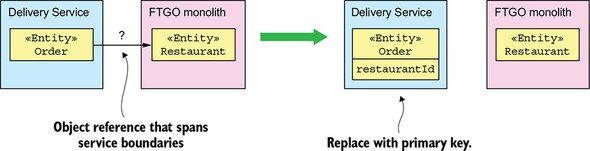
In order to extract a service, you need to extract its domain model out of the monolith’s domain model. You’ll need to perform major surgery to split the domain models. One challenge you’ll encounter is eliminating object references that would otherwise span service boundaries. It’s possible that classes that remain in the monolith will reference classes that have been moved to the service or vice versa. For example, imagine that, as figure 13.5 shows, you extract Order Service, and as a result its Order class references the monolith’s Restaurant class. Because a service instance is typically a process, it doesn’t make sense to have object references that cross service boundaries. Somehow you need to eliminate these types of object reference.
Figure 13.5. The Order domain class has a reference to a Restaurant class. If we extract Order into a separate service, we need to do something about its reference to Restaurant, because object references between processes don’t make sense.
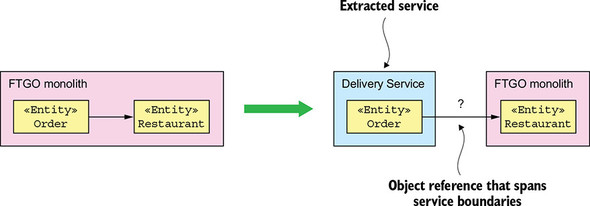
One good way to solve this problem is to think in terms of DDD aggregates, described in chapter 5. Aggregates reference each other using primary keys rather than object references. You would, therefore, think of the Order and Restaurant classes as aggregates and, as figure 13.6 shows, replace the reference to Restaurant in the Order class with a restaurantId field that stores the primary key value.
When you develop a service, you might find it challenging to maintain data consistency across the service and the monolith. A service operation might need to update data in the monolith, or a monolith operation might need to update data in the service. For example, imagine you extracted Kitchen Service from the monolith. You would need to change the monolith’s order-management operations, such as createOrder() and cancelOrder(), to use sagas in order to keep the Ticket consistent with the Order.
The problem with using sagas, however, is that the monolith might not be a willing participant. As described in chapter 4, sagas must use compensating transactions to undo changes. Create Order Saga, for example, includes a compensating transaction that marks an Order as rejected if it’s rejected by Kitchen Service. The problem with compensating transactions in the monolith is that you might need to make numerous and time-consuming changes to the monolith in order to support them. The monolith might also need to implement countermeasures to handle the lack of isolation between sagas. The cost of these code changes can be a huge obstacle to extracting a service.