concept benefit in category .net

This is an excerpt from Manning's book Concurrency in .NET.
In this book I’ll look at considerations and challenges for writing concurrent multithreaded applications in a traditional programming paradigm. I’ll explore how to successfully address these challenges and avoid concurrency pitfalls using the functional paradigm. Next, I’ll introduce the benefits of using abstractions in functional programming to create declarative, simple-to-implement, and highly performant concurrent programs. Over the course of this book, we’ll examine complex concurrent issues providing an insight into the best practices necessary to build concurrent and scalable programs in .NET using the functional paradigm. You’ll become familiar with how functional programming helps developers support concurrency by encouraging immutable data structures that can be passed between threads without having to worry about a shared state, all while avoiding side effects. By the end of the book you’ll master how to write more modular, readable, and maintainable code in both C# and F# languages. You’ll be more productive and proficient while writing programs that function at peak performance with fewer lines of code. Ultimately, armed with your newfound skills, you’ll have the knowledge needed to become an expert at delivering successful high-performance solutions.

This is an excerpt from Manning's book C# in Depth.
The example I’ll use is contrived—it’s designed to pack as many new features into as short a piece of code as possible. It’s also clichéd, but at least that makes it familiar. Yes, it’s a product/name/price example, the e-commerce alternative to “hello, world.” We’ll look at how various tasks can be achieved, and how, as we move forward in versions of C#, you can accomplish them more simply and elegantly than before. You won’t see any of the benefits of C# 5 until right at the end, but don’t worry—that doesn’t make it any less important.
There are certainly data structures that could be added in the future, but the benefit always has to be weighed against the cost of adding something to the core framework. Maybe we’ll see explicitly tree-based APIs in the future, rather than them being an implementation detail of existing collections. Maybe we’ll see Fibonacci heaps, weak-reference caches, and the like—but as you’ve seen, there’s already a lot for developers to take in, and there’s a risk of information overload.

This is an excerpt from Manning's book Dependency Injection in .NET.
As figure 1.1 shows, this chapter is fairly linear in structure. First, I introduce DI, including its purpose and benefits. Although I include examples, overall, this chapter has less code than any other chapter in the book.
Figure 1.1. The structure of the chapter is fairly linear. You should read the first section before the next, and so on. This may seem obvious, but some of the later chapters in the book are less linear in nature.
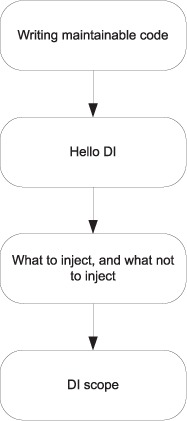
Before I introduce DI, I’ll discuss the basic purpose of DI: maintainability. This is important because it’s easy to misunderstand DI if you aren’t properly prepared. Next, after an example (Hello DI), I’ll discuss benefits and scope, essentially laying out a road map for the book. When you’re done with this chapter, you should be prepared for the more advanced concepts in the rest of the book.
The benefit of TESTABILITY is perhaps the most controversial of the benefits I’ve listed. Many developers and architects don’t practice unit testing, so they consider this benefit irrelevant at best. Others, like me, consider it essential. Michael Feathers even defines the term Legacy Application as any application that isn’t covered by unit tests.[9]

This is an excerpt from Manning's book LINQ in Action.
Another important aspect of LINQ is that when you use it, you work in a strongly typed world. The benefits include compile-time checking for your queries as well as nice hints from Visual Studio’s IntelliSense feature.
All these new features are cornerstones for LINQ, but they are integral parts of the C# and VB.NET languages and can be used separately. They represent a move by Microsoft to bring some of the benefits that exist with dynamic and functional languages to .NET developers.