concept sum in category .net

This is an excerpt from Manning's book Concurrency in .NET.
When a concurrent program runs in a multicore machine, you achieve true parallelism. In this case, CPU time becomes the sum of all the execution times for each thread running in a different CPU at same given time. In a quad-core computer, for example, when you run a single-threaded (sequential) program, the elapsed time is almost equal to CPU time because there’s only one core working. When running the same program in parallel using all four cores, the elapsed time becomes lower, because the program runs faster, but the CPU time increases because it’s calculated by the sum of the execution time of all four parallel threads. When a program uses more than one CPU to complete the task, the CPU time may be more than the elapsed time.
Figure 4.7 Benchmarking comparison of the sum of prime numbers. The benchmark runs in an eight-core machine with 8 GB of RAM. The sequential version runs in 8.072 seconds. This value is used as a base for the other versions of the code. The
Parallel.Forversion took 1.814 seconds, which is approximately 4.5 times faster than the sequential code. TheParallel.For ThreadLocalversion is a little faster than the parallelLoop. Ultimately, the PLINQ program is slowest among the parallel versions; it took 1.824 seconds to run.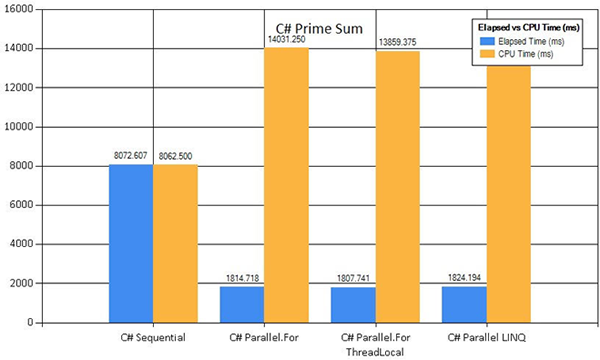
Each download operation takes an average of 0.89 seconds over five runs, for a total time of 89.28 seconds to download 100 images. These values can vary according the network bandwidth. Obviously, the time to perform multiple synchronous I/O operations sequentially is equal to the sum of the time elapsed for each individual operation, in comparison to the asynchronous approach, which by running in parallel has an overall response time equal to the slowest operation.