concept this pattern in category .net

This is an excerpt from Manning's book Concurrency in .NET.
Recursive functions are expressive and provide an effective strategy to solve complex problems by breaking them into smaller, although identical, subtasks. (Think in terms of Russian nesting dolls, with each doll being identical to the one before, only smaller.) While the whole task may seem daunting to solve, the smaller tasks are easier to solve directly by applying the same function to each of them. The ability to split the task into smaller tasks that can be performed separately makes recursive algorithms candidates for parallelization. This pattern, also called Divide and Conquer,8 leads to dynamic task parallelism, in which tasks are added to the computation as the iteration advances. For more information, reference the example in section 1.4.3. Problems with recursive data structures naturally use the Divide and Conquer strategy due to its inherent potential for concurrency.
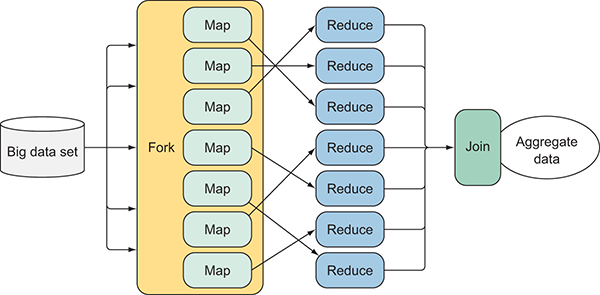
Figure 5.6 A schematic illustration of the phases of a MapReduce computation. The MapReduce pattern is composed primarily of two steps: map and reduce. The
Mapfunction is applied to all items and produces intermediate results, which are merged using theReducefunction. This pattern is similar to the Fork/Join pattern because after splitting the data in chunks, it applies in parallel the tasks map and reduce independently. In the image, a given data set is partitioned into chunks that can be performed independently because of the absence of dependencies. Then, each chunk is transformed into a different shape using theMapfunction. EachMapexecution runs simultaneously. As each map chunk operation completes, the result is passed to the next step to be aggregated using theReducefunction. (The aggregation can be compared to thejoinstep in the Fork/Join pattern.)