concept buyer in category osgi

This is an excerpt from Manning's book OSGi in Depth.
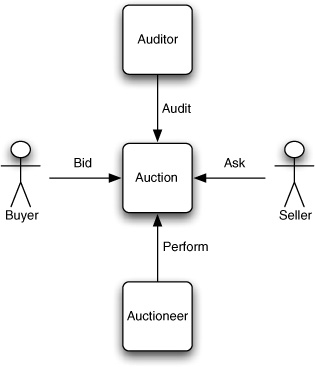
In an auction, sellers offer goods by asking a price. Conversely, buyers bid for these goods, offering their own prices that they’re willing to pay. The sellers and buyers of an action are called the auction participants. The institution that performs the auction is the auctioneer.
In an English auction, buyers can see the bids from other buyers and thus provide additional bids themselves, perhaps increasing their original offer. After some stipulated time, or when buyers cease to make bids, the buyer with the highest bid, which must be at least as high as the asking price, pays the seller for the item. In a sealed-first-price auction, each buyer can make only one bid, which is kept secret. The highest bid gets the item. There are dozens of variations on this. It’s clear that if we want to build an auction system, the system must be easily extensible to support different auction styles. This is our first requirement.
Auctions are audited. This is necessary so that we can make sure that the auctioneer is not cheating the buyers and sellers. For example, consider the stock market, which is a type of auction. The exchange market—the auctioneer—matches bids from buyers with the asking price of sellers of equities, such as stocks. You, as a buyer or seller of an equity, want to make sure that you’re paying or getting the best price you can. What you don’t want is the exchange market to select a buyer who is paying less for your equity than other buyers are willing to pay, just because the buyer happens to be an important client of the exchange—not that this would ever happen in the real world, or would it? This brings us to our second requirement: our system must allow the pluggability of different auditing applications. Figure 3.1 shows the entities of the auction system and their relationships.
Finally, let’s consider the end users of such an auction system. The end users are the buyers and sellers of goods. Some end users may want to interact with the auction system via a web interface, whereas others may prefer to use a rich-client interface. Finally, there’s even the case where the buyers and sellers are computer systems themselves, implementing some algorithmic trading, and therefore will interact via a web service with the auction system. It’s thus important that the seller and buyer components are modular and can be easily replaced or changed without impacting the overall system.