concept capability in category osgi

This is an excerpt from Manning's book OSGi in Depth.
This seemingly simple interaction caused the equipment and service providers several interesting problems. First, the devices tend to have different hardware and thus different programming APIs. Hence, each vendor had to program its applications to a specific device and then port to other devices. Second, not only do the various hardware devices use different programming APIs, but there’s also a large variation in their functions and capabilities. Some have more memory than others; some have a disk whereas others are completely diskless; some have GPS and some do not. Third, the lifetime of these devices is generally between one to two years, which means that new applications are likely to be created during this period, partly because of changing market demands. These new applications need to be dynamically deployed to the devices and join the existing collaborating applications that are currently running in the devices. And finally, because of the scarcity of the resources, these applications needed to closely cooperate with each other in a concise and, more important, lightweight manner.
Therefore, client bundles can use the service.intents property to select the appropriate service endpoint in a manner similar to that of service.imported.configs. In our case, it would allow a consuming bundle to select an endpoint that keeps the remote method invocations ordered. In other words, on the importing side, the service.intents property specifies the capabilities of the remote service, as shown in figure 10.5.
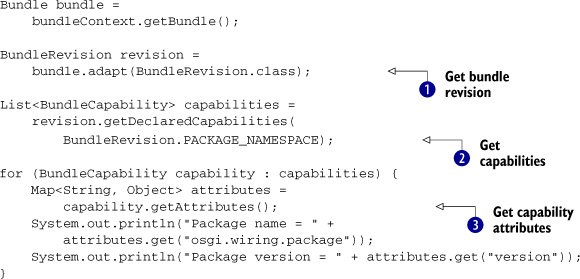
Does it seem far-fetched? Perhaps, but we already have most of the pieces. Dependencies between bundles can already be specified in OSGi using the regular import-package mechanism. Furthermore, starting in version 4.3 of the OSGi Service Platform, there’s a generic mechanism for the specification of general requirements and capabilities. You can think of the import-package and export-package headers respectively as a particular case of a requirement and a capability specification.