concept React router in category react

This is an excerpt from Manning's book React in Action.
What about React Router?
You might have heard of React Router before if you’ve worked with React at all. It’s one of the most popular React projects in open source and is by far the most popular routing solution for React applications. You may wonder why you don’t just install React Router and learn how to use that API. You could do that, but I think you’d miss out on the chance to see how you can do things with React components that you might not expect (such as mapping URLs to components!). You’ll learn far more from building something yourself than you will by simply installing something with npm.
React Router (https://github.com/ReactTraining/react-router) seems to be the single most-used and most-developed routing solution for React. It enjoys a robust following and community of contributors on GitHub and has gone through several major revisions.

This is an excerpt from Manning's book React Quickly: Painless web apps with React, JSX, Redux, and GraphQL.
React isn’t a full-blown, Swiss Army knife–type of framework. Developers need to pair it with a library like Redux or React Router to achieve functionality comparable to Angular or Ember. This can also be an advantage if you need a minimalistic UI library to integrate with your existing stack.
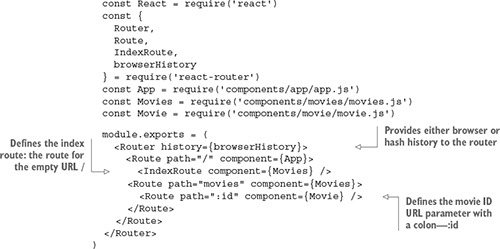
And the ternary expression renders either this.previousChildren or this.props.children. React Router populates this.props.children from other nested routes/components, such as Index and Product. Remember that App is used by almost all of the app’s screens. By default, you want to render this.props.children when working with React Router: