concept option in category seam

This is an excerpt from Manning's book Seam in Action.
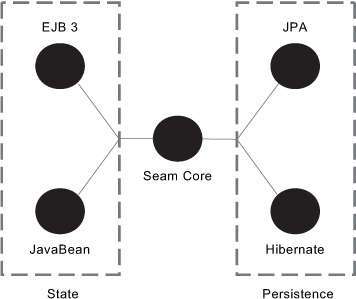
Seam is not just a collection of classes and artifacts that get dropped on your desk with the disclaimer “Some assembly required.” The key to Seam’s success is that it offers a handful of well-tested bundles that operate fluently. These bundles include compatible versions of many third-party libraries. You can liken the offering to the simplicity of buying a Mac when compared to buying a Dell. When you buy a Dell, you can customize the assembly down to the last stick of RAM. You get a product customized exactly to your needs, but getting there requires a lot of thought and effort on your part. Buying a Mac is much simpler in comparison. You choose between a laptop and a notebook, and then you select a screen size. Everything else is just details that Apple works out for you. Seam has a comparable set of options. You choose a state provider and a persistence provider (and, down the road, a web framework). Everything else is just details that the Seam developers work out for you. By removing the burden of too many choices, Seam can make life for the developer simpler.
With this component in hand, you’re now ready to learn how to define the conversation boundaries. As you read through the next couple of sections, I encourage you to study the options you have for defining these boundaries, decide on a favorite approach, and try to adhere to it a majority of the time. Just because you can define each boundary a handful of ways doesn’t mean you should use every single variation, at least not without good reason.