concept information in category search

This is an excerpt from Manning's book Deep Learning for Search.
We’ve had a closer look at how a search engine works, in particular how it strives to retrieve information relevant to the end user’s needs. But let’s take a step back and try to see the problem from the perspective of how, as users, we use search engines every day. We’ll examine some of the problems that remain unresolved in many search scenarios, in order to better understand which issues we can hope to solve with the help of DL.
Filling a knowledge gap, as opposed to retrieving information, is a slightly more complex topic. Let’s again take the example of going to a library, because you want to know more about interesting recent research in the field of AI. As soon as you meet the librarian, you have a problem: how do you get the librarian to accurately understand what you need and what would be useful to you?
Although this sounds simple, the usefulness of a piece of information is hardly objective, but instead is rather subjective and based on context and opinion. You may assume that a librarian has enough knowledge and experience that what you receive is good. In real life, you would probably talk to the librarian to introduce yourself and share information about your background and why you need something; that would allow the librarian to use such context in order to
In the early days of the internet and search engines (late 1990s), people only searched for keywords. Users might have typed “movie zemeckis future” to find information about the movie Back to the Future, directed by Robert Zemeckis. Although search engines have evolved, and today we can type queries using natural language, many users still rely on keywords when searching. For these users, it would be advantageous if the search engine could generate a proper query based on the keywords they type: for example, taking “movie Zemeckis future” and generating “Back to the Future by Robert Zemeckis.” Let’s call the generated query an alternative query, in the sense that it’s an alternative (text) representation of the information need expressed by the user.
Chapter 1 talked about the fundamental problem of how users can best express an information need. But as a user, do you really want to spend a lot of time thinking about how to word a query? Imagine yourself on your way to work on public transport early in the morning, searching for information on your phone. You don’t have the time or the brainpower (it’s early!) to come up with the best way to interact with a search engine.
If you ask users to explain the information they need in three or four sentences, you’re likely to get a detailed explanation of the specific need and its detailed context. But if you ask the same person to express what they’re looking for in a short query of no more than five or six words, the chances are high that they won’t be able to do it, because it’s not always easy to compress a detailed requirement into a short sequence of words. As search engineers, we need to do something to bridge this gap between user intent and the resulting queries.

This is an excerpt from Manning's book Relevant Search: With applications for Solr and Elasticsearch.
In a short time, you experienced the product of many thousands of hours of engineering effort. You engaged with the culmination of an even larger body of academic research that goes back a century in the field of information retrieval. Standing on the shoulders of giants, you sifted through millions of pieces of information—the entire human collection of information on the topic—and found the best reviewed and most popular TV in mere minutes.
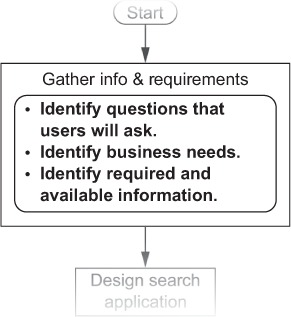
Before building a search application, take time to consider the needs and expectations of all stakeholders. This is the next step in our process, as shown in figure 9.3. Most obviously, search should be easy to use and helpful for users. But Yowl is a search-driven business, so it must also meet business needs. In this section, we look at both user and business needs. We identify the information required to meet these needs and we describe potential sources for this information.

This is an excerpt from Manning's book Lucene in Action, Second Edition.
The explosion of the internet and digital repositories has brought large amounts of information within our reach. With time, the amount of data available has become so vast that we need alternate, more dynamic ways of finding information (see figure 1.1). Although we can classify data, trawling through hundreds or thousands of categories and subcategories of data is no longer an efficient method for finding information.
In this book we’ve treated the Lucene index more or less as a black box and have concerned ourselves only with its logical view. Although you don’t need to understand index structure details in order to use Lucene, you may be curious about the “magic.” Lucene’s index structure is a case study in itself of highly efficient data structures to maximize performance and minimize resource usage. You may see it as a purely technical achievement, or you can view it as a masterful work of art. There’s something innately beautiful about representing rich structure in the most efficient manner possible. (Consider the information represented by fractal formulas or DNA as nature’s proof.)