concept recommendation in category search

This is an excerpt from Manning's book AI-Powered Search.
In order to deliver AI-powered search, it’s important that we establish up-front a cohesive understanding of the many dimensions involved in interpreting user intent and subsequently returning content matching that intent. Within the field of information retrieval, search engines and recommendation engines are the two most popular technologies employed in an attempt to deliver users the content needed to satisfy their information need. Many organizations think of search engines and recommendation engines as separate technologies solving different use cases, and indeed it is often the case that different teams within the same organization - often with different skillsets - work independently on separate search engines and recommendation engines. In this section, we’ll dive into why separating search and recommendations into separate silos (independent functions and teams) can often lead to less than ideal outcomes.
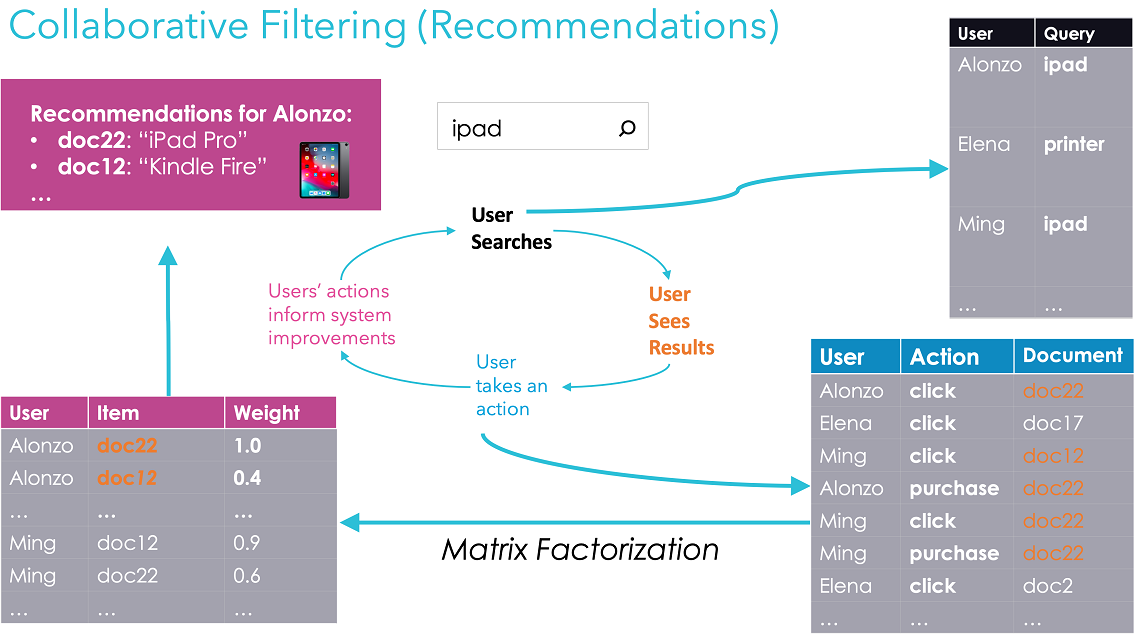
Figure 4.6. Collaborative filtering for user-to-item recommendations. Based upon his past behavior, our user (Alonzo) receives recommendations based upon items other users liked, where those users also interacted with the same items as Alonzo.
This is an excerpt from Manning's book Deep Learning for Search.
The contents of the Related box can even shift the user’s intent toward topics that are far from the initial query. In the previous example, the user wanted to learn how to use Lucene. The search engine provided a related item whose main topic wasn’t directly related to Lucene: it was about building a machine learning system for generating recommendations based on Lucene. That’s a big switch, from needing information about working with Lucene as a beginner to learning about recommender systems based on Lucene (a more advanced topic).

This is an excerpt from Manning's book Relevant Search: With applications for Solr and Elasticsearch.
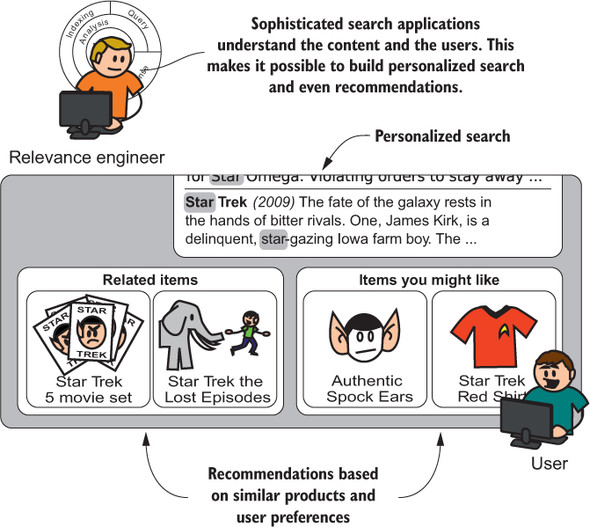
In the process of laying out personalized search, we introduce recommendations. You can provide users with personalized content recommendations even before they’ve made a search. In addition, you’ll see that a search engine can be a powerful platform for building a recommendation system. Figure 11.1 shows recommendations side-by-side with search, implemented by a relevance engineer.
Maybe search is not the application you should be building. Maybe you should be building recommendations.
Consider what happens if there’s no explicit search in a personalized, concept-based search application. What if the search box is left empty and filters left unchecked? Can the application still be put to use? Yes! Even without immediate input from the user, the application has a significant amount of context that can be used to make rich recommendations. For instance, if the user looks at an item detail page, then the application can use methods discussed in this chapter to recommend related items. If the user interacted with the application in the past, the recommendations can incorporate the user’s behavioral and conceptual information so that the recommendations will be personalized. So you see, recommendation is something that can still exist without an explicit query from the user. As we’ll show in the following paragraphs, it may even be useful to think of search as a subset of recommendation.
As the preceding story illustrates, recommendation could be seen as an overarching and unifying concept—which happens to include the notion of search. Here’s a formal definition:
Recommendation is the ability to provide users with the best items available based on the best information at hand.