concept ability in category software development

This is an excerpt from Manning's book Writing Great Specifications: Using Specification by Example and Gherkin.
Don’t get too used to the Feature keyword. In chapter 8, you’ll replace it with more-advanced keywords such as Ability and Business Need that allow for better categorization of requirements.
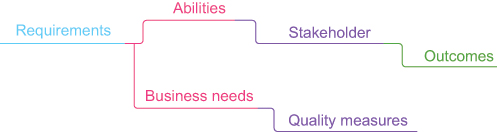
It’s not that the previous business need was bad; it just outgrew its purpose. Business needs are used to identify areas where new stakeholders may potentially emerge. As soon as that happens, you can begin working with the stakeholders to develop their areas of interest—and abilities are much better for doing that (see figure 9.4).

This is an excerpt from Manning's book Test Driven: Practical TDD and Acceptance TDD for Java Developers.
The fundamental idea is that the way to achieve the best possible level of productivity for the whole team is to nurture rapid feedback and effective, face-to-face communication around concrete, working software instead of passing around test plans, requirements specifications, and bug reports between customers, testers, business analysts, and developers. With acceptance TDD, we are able to collaborate effectively by bringing together the knowledge, skills, and abilities required for doing a good job.
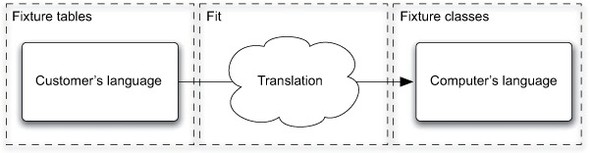
Figure 10.2. The Fit framework translates the customer’s language encoded in fixture tables into the computer’s language encoded in fixture classes. The fixture classes can be implemented with a variety of programming languages, typically—but not necessarily—in the same language as the system under test is implemented. Scripting languages, for example, are often a good candidate for implementing the backing code for fixture tables due to their flexibility and ability to integrate with other technologies.
The champion is an important role, because they serve as the ultimate source for motivation and energy. Luckily, the role of the champion can (and should, at least eventually) be distributed among several individuals who are able and willing to take on this task. Speaking of roles, the change champion is a virtual role that is added to the individual’s formal roles and responsibilities, and these other roles affect our chances of getting others aboard. Let’s take a closer look at how the formal role of a champion can influence that person’s ability to lead change within the group.