concept company in category software development
This is an excerpt from Manning's book Writing Great Specifications: Using Specification by Example and Gherkin.
Sounds reasonable, doesn’t it? The capabilities for both the employees of the company and its customers are clearly defined. But are they really?
Listing 8.1. [OK] Specification derived from a user story as a feature
Feature: Branches and departments Scenario Outline: Employees should only see content relevant to them Given <person> from <branch> who works in <department> When <person> looks at the company dashboard on Activitee Then <person> should see <type> <content> Examples: Employees should see after-work content only from their location | person | branch | department | type | content | | Jane | New York | Engineering | New York after-work | events | | Mike | New York | HR | New York after-work | posts | | Tom | Atlanta | Sales | Atlanta after-work | events | | Ramona | Atlanta | Engineering | Atlanta after-work | posts | Examples: Employees should see work-related content from all locations | person | branch | department | type | content | | Mike | New York | HR | Atlanta HR | events | | Jane | New York | Engineering | Atlanta engineering | posts | | Jane | New York | Engineering | New York engineering | events | | Tom | Atlanta | Sales | Atlanta sales | events | | Ramona | Atlanta | Engineering | Atlanta engineering | posts | | Ramona | Atlanta | Engineering | New York engineering | events |
Each bounded context needs to figure out how to communicate with other bounded contexts, just as different departments learn to share information within a company.

This is an excerpt from Manning's book Becoming Agile ...in an imperfect world.
VersionOne’s data shows that agile does help in key areas related to software development, with increased productivity, fewer defects, quicker time to market, and reduced costs. We have witnessed similar results with the companies we’ve helped move to agile.
The VersionOne survey provides proof that agile worked for most of the companies interviewed, but the main question for most people remains: “Will agile help my specific company with my specific situation?” Agile will help your company if you have changing requirements and a need to deliver functioning software frequently. If your requirements rarely change and you have the luxury of delivering when you feel the product is satisfactory, then you may not obtain the full benefits recorded in VersionOne’s survey. (Note that we’ve never worked for any companies where this was true.)
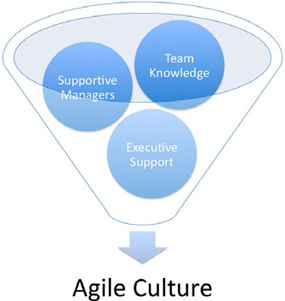
Executives are just like everyone else. They have specific needs, and whenever a major initiative is suggested, they want to know what the benefits are for the company and for themselves. In this chapter, we’ll show you how to obtain executive support for agile by addressing the specific needs of your company’s executives.
Jim explained to Steve that Acme didn’t need new tools and might find that it could dispense some of its current tools. Companies can support agile with spreadsheets or even hard-copy plans and features taped to a wall. A lot of teams get by with a large whiteboard.