concept development in category software development
This is an excerpt from Manning's book Writing Great Specifications: Using Specification by Example and Gherkin.
This chapter offers an overview of what a specification is and how SBE and Gherkin fit into the software development landscape. If you’re a non-engineer, you’ll learn how to make essential contributions to automated testing without having to learn to write testing code. (Don’t worry about technical lingo. I use it rarely and explain it when I do.) Engineers and testers will find SBE and Gherkin helpful in striking a stronger chord with nontechnical audiences through automated specifications. You’ll also begin to see SBE as a single process to guide product development through requirements analysis, design, development, testing, and so on.
Outside-in terminology and behavior-driven development


This is an excerpt from Manning's book Agile ALM: Lightweight tools and Agile strategies.
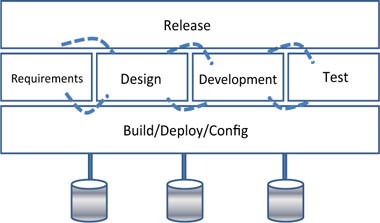
Figure 1.3. Development phases like design and development are often unreliable with unpredictable results, tools, and data. Phases are isolated and only loosely linked, as illustrated by the dotted lines in the figure. SCM activities like build/deploy are orthogonal to the phases and span them. They are often not reliable.
Integrating code can be difficult. Developers must work on their code in isolation and must keep up with the functions completed by other developers. As a centralized synchronization point, the VCS and the continuous integration (CI) server help with this effort. The VCS contains the successfully integrated code; think of it as being the authoritative single source of truth. During development, developers are continuously committing to and updating from the codebase in the VCS. A typical sequence of activities can look like this:

This is an excerpt from Manning's book Specification by Example: How Successful Teams Deliver the Right Software.
“Any system that didn’t have the tests [living documentation] would halt the development and it would have been a re-write.”
The Talia project team at Pyxis Technologies in Montreal, Quebec, had a similar experience. Talia is a virtual assistant for enterprise systems, a chat robot with complex rules that communicates with employees. From the first day of development, the Talia team used Specification by Example to build a living documentation system. A year later, they had to rewrite the core of the virtual agent engine from scratch—and that’s when the investment in living documentation paid off. André Brissette, the Talia product director, commented,
Introduce automated executable specifications, for teams that have test automation separate from development.

This is an excerpt from Manning's book Becoming Agile ...in an imperfect world.
Welcome changing requirements, even late in development. Agile processes harness change for the customer’s competitive advantage. Your customers are competing in a dynamic market, and therefore they may have to change the requirements for their software in order to gain a competitive advantage. It is important to note that you should welcome changing requirements, but no one said this change is free.
In the past, Acme Media sought feedback from the customer after development was complete. Using this approach, Acme Media’s team frequently found the customer had functionality issues with the code that was developed. The issues went beyond bugs: they frequently tied to the customer saying the code didn’t meet their needs. Acme tried to address as many issues as possible before going live, and if major issues couldn’t be fixed quickly, they delayed shipping the product.
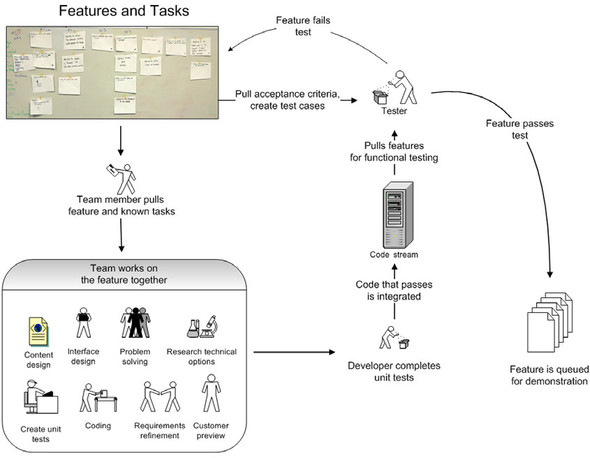
Welcome changing requirements, even late in development.