concept list in category software development

This is an excerpt from Manning's book Seriously Good Software: Code that works, survives, and wins.
First of all, often the users themselves don’t exactly know what services they need— they need time and assistance to figure that out. Second, fulfilling those needs isn’t the end of the story at all. Those services may be offered more or less quickly, with more or less accuracy, after a long user training or after just a quick glance at a well-designed UI, and so on. In addition, over time you need to modify, fix, or improve any system, which leads to more quality variables: How easy is it to understand the system’s inner workings? How easy is it to modify and extend it without breaking other parts? The list goes on and on.
Standard Java collections are eager (the opposite of lazy). Java 8 introduced the streams library, a powerful framework for manipulating data sequences. Among other features, streams employ lazy evaluation. To appreciate the difference, start with a list of integers list. If you run
list.sort(null);it will immediately sort the list, because the list is eager. (The null here signals that integers have a natural order, so no comparator is needed.) On the other hand, try converting that list to a stream and then sorting the stream:
public class IntStats {
   private long sum;                     #1 The current sum of all integers
   private List<Integer> numbers = new ArrayList<>();

   public void insert(int n) {
      numbers.add(n);
      sum += n;
   }
   public double getAverage() {
      return sum / (double) numbers.size();
   }
   public double getMedian() {
      Collections.sort(numbers);        #2 Library method for sorting a list
      final int size = numbers.size();
      if (size \% 2 == 1) {              #3 Odd size
         return numbers.get(size/2);
      } else {                          #4 Even size
         return (numbers.get(size/2 -1) + numbers.get(size/2)) / 2.0;
      }
   }
}


!@%STYLE%@!
{"css":"{\"css\": \"font-weight: bold;\"}","target":"[[{\"line\":1,\"ch\":41},{\"line\":1,\"ch\":43}],[{\"line\":12,\"ch\":40},{\"line\":12,\"ch\":42}],[{\"line\":14,\"ch\":41},{\"line\":14,\"ch\":43}],[{\"line\":16,\"ch\":40},{\"line\":16,\"ch\":42}]]"}
!@%STYLE%@!
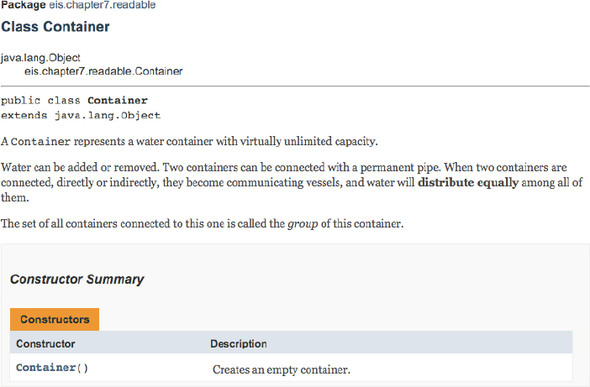
Figure 7.1. A snapshot of Javadoc-generated HTML documentation for Readable, including a class description and a list of constructors
This is an excerpt from Manning's book Writing Great Specifications: Using Specification by Example and Gherkin.
If you’re using Bundler, you can add gem 'rspec-expectations' to your Gemfile, instead. Bundler provides a consistent environment for Ruby projects by tracking and installing the exact gems and versions that are needed. Therefore, you can list the gems your project requires in a Gemfile and install them all at once, instead of going through the list one by one.
Even though user stories shouldn’t by any measure replace conversations, you can prepare notes in advance that will help you get up to speed after you pull a story out of the product backlog. (A backlog is a lot like a freezer: some stories don’t age well.) You don’t want to be overly specific, of course. Specificity at this stage could constrain your flexibility in the future. You should never treat user stories as a to-do list. They’re more like a list of guidelines: directions that you suspect you might explore in the future. But stories can stay in the freezer for months, so you may want to provide some details to remind you of its purpose back when you put that particular story in the backlog.


This is an excerpt from Manning's book Test Driven: Practical TDD and Acceptance TDD for Java Developers.
Well-written code exhibits good design and a balanced division of responsibilities without duplication—all the good stuff. Poorly written code doesn’t, and working with it is a nightmare in many aspects. One of them is that the code is difficult to understand and, thus, difficult to change. As if that wasn’t enough of a speed bump, changing problematic code tends to break functionality elsewhere in the system, and duplication wreaks havoc in the form of bugs that were supposed to be fixed already. The list goes on.
Now that we know that we should split our requirements into small, focused tests rather than tasks, and now that we understand how to progress through the list of tests by programming by intention, it’s time to get busy developing a world class template engine test-first.
We’ve got a list of tests that tell us exactly when the requirements have been fulfilled. Next, we start working through the list, making them pass one by one.
Listing 4.10. Example of the Delta Assertion pattern
public class TestAddingToArrayList { private ArrayList<String> list; // setup method omitted for brevity @Test public void sizeOfListReflectsItemsAddedToIt() throws Exception { int sizeBefore = list.size(); // record the "before" state list.add("something"); assertEquals(sizeBefore + 1, list.size()); // delta verification } }