concept practice in category software development

This is an excerpt from Manning's book Seriously Good Software: Code that works, survives, and wins.
The principle of separation of concerns also provides the very footing for this book. The many implementations I present in the following chapters comply with the same public API, and therefore, in principle, clients can use them interchangeably. The way each implementation realizes the API is appropriately hidden from the outside, thanks to the visibility specifiers. At a deeper level, the very notion of individually optimizing different software qualities is an extreme instance of separation of concerns. It’s so extreme, in fact, to be merely a didactic tool and not an approach to pursue in practice.
In practice, the new Container class, called Speed1, has a single field:
In the second scenario, amortized analysis like the one we performed on Speed3 is a formal way to ascertain the value of a time investment in the long run. Both techniques are heavy on the brain and light on the fingers—no need to create the software and run it. In practice, the easiest (though not the quickest) path is to implement and profile different solutions. This path is also the most accurate, as long as the operating conditions remain similar to those used for profiling.

This is an excerpt from Manning's book Writing Great Specifications: Using Specification by Example and Gherkin.
Specification by example, a set of practices that sprang from the agile acceptance--testing tree, is a collaborative approach to defining software requirements based on illustrating executable specifications with concrete examples. It aims to reduce the level of abstraction as early in the process as possible, getting everyone on the same page and reducing future rework.
Let’s assume that the distillation process is finished, and you’ve extracted all the relevant subdomains. You end up with a complete list of actors and their abilities, prepared based on the practices covered in chapter 8, as well as several business needs that specify a few functional aspects of your nonfunctional requirements (see figure 10.4).

This is an excerpt from Manning's book Kanban in Action.
“But how do we do this in practice?” Eric wanted to know. “What do we change?”
In theory, these things have quite different meanings; but in practice, people in the community often don’t distinguish between them. What people typically refer to as “using kanban” is to use some sort of kanban system to manage and optimize kanbans (the visual signals) in order to evolutionarily improve. That is what we mean when we use the word kanban.
There are a lot of things you can do to accomplish this. When working with this principle, you can find inspiration in Lean Thinking to help your work flow more smoothly by removing waste in your process. You can also take a look at the Theory of Constraints[3] and identify, exploit, and alleviate the bottlenecks in your system. Practices from the agile software development community movement might help you to improve collaboration and quality and thereby improve the flow of your system. It’s up to you which route you take to improve your system. The important thing is that you react to the signals that your work is sending you and improve on it.

This is an excerpt from Manning's book Specification by Example: How Successful Teams Deliver the Right Software.
Collaborating on specifications isn’t something that only agile teams can benefit from. In Bridging the Communication Gap,[†] I suggested that a similar set of practices could be applied to more traditional structured processes. After the book was published, I came across an example of a company that did just that while researching this book.
Capturing acceptance criteria with scripts instead of specifications costs a lot of time in the long term, and we can save this time if we take a few minutes to restructure the examples up front. For an example of how to refine such scripts to more useful specifications, see the “Refining in practice” section at the end of this chapter. Rick Mugridge and Ward Cunningham have a lot of good advice on restructuring scripts to be better specifications in Fit for Developing Software (Prentice Hall, 2005).

This is an excerpt from Manning's book Event Processing in Action.
We give two meanings to the word event. The first meaning refers to an actual occurrence (the something that has happened) in the real world or in some other system. The second meaning takes us into the realm of computerized event processing, where the word event is used to mean a programming entity that represents this occurrence. It’s easy to get caught up in a rather pedantic discussion about the difference between these two, but in practice we can safely use the word event to have either meaning as it’s usually easy to tell the meaning from the context. You should note that a single event occurrence can be represented by many event entities, and also be aware that a given event entity might capture only some of the facets of a particular event occurrence.
In theory, there is no difference between theory and practice; in practice, there is.

This is an excerpt from Manning's book Becoming Agile ...in an imperfect world.
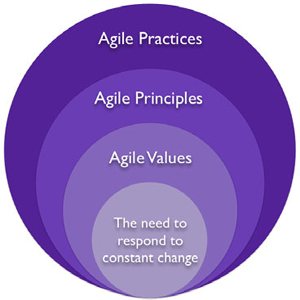
Many people may think that agile is just another software development process. Although that is true to a degree, there is a lot more to agile than just a process or just a set of practices. Agile (or agility) is more of a mindset—a way of thinking about software development. This agile mindset can be applied to any process using any set of practices. The best way to illustrate our understanding of agile is through figure 1.2.
Table A.3. Continuous customer feedback
CCF This refers to any mechanism to elicit continuous customer feedback about the product. This is important to ensure that the customer is satisfied with what is being developed and that it meets their business needs and expectations. This is contrary to the practice of gathering feedback after the product is completely developed. Various characteristics to be assessed to determine the team’s readiness for this practice Indicators Customer feedback existence Whether the team has a method by which they gather continuous feedback/criticism from the customer during the development process CCF_M1, CCF_M2 Developer buy-in Whether the developers accept the fact that the customers are encouraged to continually rethink their requirements CCF_D1, CCF_D2, CCF_D3 Management buy-in Whether the managers accept the fact that the customers are encouraged to continually rethink their requirements CCF_M3, CCF_M4, CCF_M5 Indicators (questions) to be answered by the manager(s) CCF_M1 The customer should have the opportunity to give his/her feedback about the product throughout the development process by means of interacting with a working piece of software. Strongly Disagree Tend to Disagree Neither Agree nor Disagree Tend to Agree Strongly Agree CCF_M2 The team has a method by which it gathers continuous feedback/criticism from the customer during the development process. Strongly Disagree Tend to Disagree Neither Agree nor Disagree Tend to Agree Strongly Agree CCF_M3 Customers should be encouraged to regularly change their expectations for the product being developed to ensure that the product satisfies their business priorities. Strongly Disagree Tend to Disagree Neither Agree nor Disagree Tend to Agree Strongly Agree CCF_M4 As the perception of what they need changes, customers are expected to articulate those changes and so affect the product being built. Strongly Disagree Tend to Disagree Neither Agree nor Disagree Tend to Agree Strongly Agree CCF_M5 The customer should give his/her feedback throughout the development process even if it means that requirements must be changed. Strongly Disagree Tend to Disagree Neither Agree nor Disagree Tend to Agree Strongly Agree Indicators (questions) to be answered by the developers CCF_D1 Customers should be encouraged to regularly change their expectations for the product being developed to ensure that the product satisfies their business priorities. Strongly Disagree Tend to Disagree Neither Agree nor Disagree Tend to Agree Strongly Agree CCF_D2 The team has a method by which it gathers continuous feedback/criticism from the customer during the development process. Strongly Disagree Tend to Disagree Neither Agree nor Disagree Tend to Agree Strongly Agree CCF_D3 The customer should give his/her feedback throughout the development process even if it means that requirements must be changed. Strongly Disagree Tend to Disagree Neither Agree nor Disagree Tend to Agree Strongly Agree

This is an excerpt from Manning's book Test Driven: Practical TDD and Acceptance TDD for Java Developers.
In these situations, it often makes sense to run a subset of the tests (a subset that’s most likely to catch any bugs introduced by the change), check in, and leave a build server crunching through the rest of the tests in the background while we move on with our next task. These build servers are sometimes referred to as continuous integration servers due to the fact that they are often used in conjunction with the practice of continuous integration[10]—developers integrating their changes frequently in such small increments that it’s almost continuous.
A typical example of an end-to-end scenario is to write acceptance tests for a web application using a library, such as jWebUnit. The jWebUnit source repository includes a Fit fixture class for using jWebUnit with Fit.[3] In practice, we would extend from jWebUnit’s WebFixture and create our own vocabulary on top of jWebUnit’s API, as illustrated in listing 11.1.
In the one-to-many scenario, the test client is load-balancing individual test cases between multiple target systems. This setup has the benefit of the test client being able to run another test case while the other is blocked, waiting for the system under test to respond. In practice, this is a simple setup that only requires a simple multithreaded test runner and that scales well as long as the source of slowness is mostly within the system under test (such as test setups populating the underlying database) and not, for example, in the communication overhead or in the test parsing the system’s responses.