concept process in category software development

This is an excerpt from Manning's book Five Lines of Code.
In this chapter, we describe a concrete way to identify methods that likely have too many responsibilities. As an example, we look at a specific method in our 2D puzzle game that is doing too much:
draw. We show a structured, safe way to improve the method while eliminating comments. Then, we generalize this process to a reusable refactoring pattern: Extract method [P3.2.1]. Continuing with the same exampledrawmethod, we learn how to identify another problem of mixing different levels of abstraction and how Extract method [P3.2.1] can also alleviate this issue. In the process, we learn about good method-naming habits.After concluding our work with
draw, we continue with another example — theupdatemethod — and repeat the process, refining how we work with the code without diving into the details of it. This example teaches us to identify a different symptom that a method is doing too much; and through Extract method [P3.2.1], we learn how to improve readability by renaming variables.
8.5.1. Invariants in the process
That something is undone (todo), is (probably) erroneous (fixme), or is a work-around of some third party software (hack) are all invariants. Not invariants in the code, but invariants of the process. Some people despise these, and argue justly that they should not be in the code but in our ticket system. I agree that this is also perfectly value, although I do prefer the locality of comments directly in the code. If they are in the code though there should be some visual indication of how many there are, and this number better be going down. We should stride towards actually fixing or doing the thing they are noting, so we can remove them, rather than postponing it further.
This is an excerpt from Manning's book Writing Great Specifications: Using Specification by Example and Gherkin.
Specification by example, a set of practices that sprang from the agile acceptance--testing tree, is a collaborative approach to defining software requirements based on illustrating executable specifications with concrete examples. It aims to reduce the level of abstraction as early in the process as possible, getting everyone on the same page and reducing future rework.
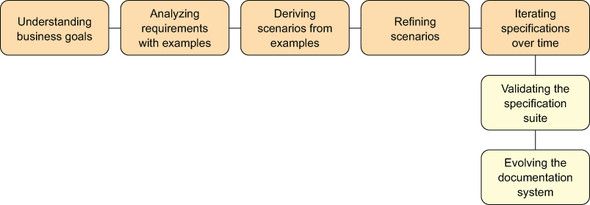
The process you’ve been using throughout the chapter to elicit requirements is similar in design to feature injection: a technique that iteratively derives scope from goals through high-level examples.[a] In feature injection, teams first “hunt for value” by creating a model for delivering business value and listing underlying assumptions instead of trying to describe the value with simple numbers such as revenue goals. You created a simple model for value delivery when we discussed Mapper’s short-term and long-term goals, why the goals are important, how they influence Mapper’s business model, and which stakeholders demand that you achieve the metrics.
This is an excerpt from Manning's book The Mikado Method.
When you perform small changes, you can keep them in your head, but for larger ones, the chances of getting lost in a jungle of dependencies, or on a sea of broken code, increases dramatically. The Mikado Method can help you visualize, plan, and perform business value–focused improvements over several iterations and increments of work, without ever having a broken codebase during the process.
Figure 1.3 shows what the Mikado Method looks like in a compound format. It shows our recommendation for performing changes to a system that’s too large for analyze-then-edit, which means basically any production system in the world. Let’s go through the steps of the process one by one.

This is an excerpt from Manning's book Kanban in Action.
“Which leads us to the next step in limiting work in process,” Marcus interrupted, concerned that Joakim was about to go off on a tangent, “which is to use visualization to make the limits explicit and specific. We choose a maximum number of work items that we’re allowed to have in progress at the same time.”
“This limitation will help us focus on getting stuff finished and help the work to flow faster through the system.” Joakim was back on track again. “Limiting your work in process will help you with a couple of the challenges listed at the outset. First, things will start to move along so you’ll stop have people breathing down your neck.”
Work in process (WIP) is a phrase that you’ll hear a lot in the kanban community or when reading about Lean. WIP seems to be something that you don’t want or at least want as little of as possible, so you often hear kanban aficionados talking about “limiting” WIP.
This chapter will help you to understand what WIP is, what could happen if you allow a lot of WIP in your process, and, finally, some ways to help you to limit work in process.
Work in process means all the work that you have going on right now. That includes work you’re actively working on right now, work items waiting to be verified or deployed, and also the work sitting in your inbox that you haven’t started yet: all the unfinished things you need to do in order to deliver value to the end customer.

This is an excerpt from Manning's book Agile ALM: Lightweight tools and Agile strategies.
Figure 1.4. The first evolution of SCM toward an approach that can be called ALM spread over phases and synchronization. Unlike the design in figure 1.3, single phases now contain aspects of ALM but often have disparate data stores and processes, and there are challenges to sharing data and knowledge.
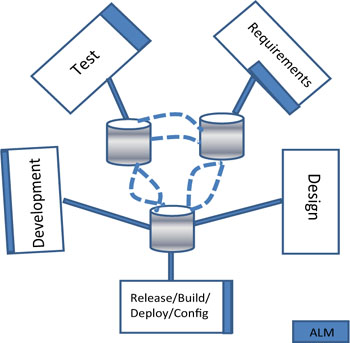
Defining processes and tools
Project management in an Agile environment requires an approach that can handle the frequent changes that exist in iterative development. Agile project management provides transparency and traceability in an environment that thrives on constant change. Everything the team does must add value to the system. The process must be open to changes and be highly organized and disciplined. Continuous cooperation and awareness are indispensable for responsibility, permanent reflection, and synchronization.
To resolve this conflict, you need to focus on priorities, including the root cause of the process pitfall. Often, more process is introduced in order to address the problem of the illusion of control. Introducing too many rules or wrong process rules could suggest control that doesn’t truly exist. In the worst case, you have a described process and a real process in parallel. Or you have a rigid process that dramatically decreases productivity. ALM and its major facet, release management, must be a balanced set of processes and tools aligned with your individual requirements.

This is an excerpt from Manning's book Specification by Example: How Successful Teams Deliver the Right Software.
Quick feedback is an essential part of developing software in short iterations or in flow mode, so we need to make the process of validating the system cheap and efficient. An obvious solution is automation. But this automation is conceptually different from the usual developer or tester automation.
When looking for a better way to align development and testing, they automated tests in human-readable form. After that, they discovered that tests can become specifications. Moving to executable specifications got them to collaborate better. In the course of refining the process, they had to make continuous validation more reliable, which led them to improve how they refine the specifications. When looking for better ways to engage business users, they started to derive scope from goals.

This is an excerpt from Manning's book Becoming Agile ...in an imperfect world.
Ensure company buy-in. We’ll walk you through the steps for obtaining executive management, line management, and team support, ultimately leading the team to ownership of the process.

Appendix D. Example: determining process and document needs for a project
Throughout the book we have mentioned the need for the project team to determine the documentation and processes required for each project. In the example below we show an example from a real team. This team worked in a regulated environment and had to provide requirements traceability. Note that they revisited this matrix at the start of each project to reach agreement on what the deliverables would be. This matrix was originally one spreadsheet, but we have broken it into two pages to make it easier to view within the book.

This is an excerpt from Manning's book Test Driven: Practical TDD and Acceptance TDD for Java Developers.
The process is much like the TDD cycle on the code level. With acceptance TDD, we’re just talking about tests for the behavior of a system rather than tests for the behavior of objects. This difference also means that we need to speak a language that both the programmer and the customer understand.
The process is largely dependent on the availability of the customer and the test and software engineers. If your customer is only onsite for a few days in the beginning of each iteration, you probably need to do some trade-offs in order to make the most out of those few days and defer work that can be deferred until after the customer is no longer available. Similarly, somebody has to write code, and it’s likely not the customer who’ll do that; software and test engineers need to be involved at some point.
But now, I present you with the process of acceptance test-driven development, distilled into four small steps.