concept product in category software development

This is an excerpt from Manning's book Writing Great Specifications: Using Specification by Example and Gherkin.
Building the product Launching the product
Our area of interest lies in the upper half of the matrix, though: it’s split into tests that support the team’s progress and tests that critique the product. Tests that support the team help the team write new code before they have a working product. Tests that critique the product look at a finished product with the intent of discovering inadequacies. As you can see, this is similar to the feedback system that powers any human organization.
The question we’ll explore throughout this chapter is when examples should support the team’s work and when they should critique the product. You’ll see how examples and automation can give delivery teams feedback of both kinds. And you’ll come to understand how feedback forces at the core of every executable specification suite work much like a development manager: constantly evaluating the job done by programmers, analysts, designers, and testers; praising the team for their successes; and pointing out failures.

This is an excerpt from Manning's book Agile Metrics in Action: How to measure and improve team performance.
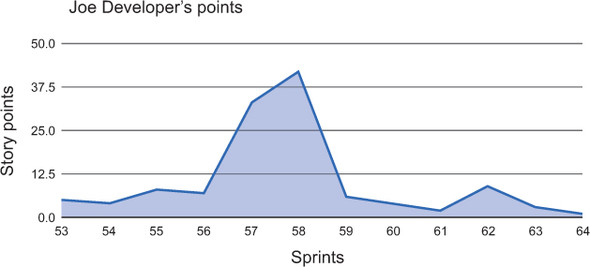
After showing that to leadership, everyone agrees that the team needs to be more consistent. But what’s causing the problem? The development team decides to pull data from all the developers across all projects to see if there’s someone in particular who needs help with their work. Lo and behold, they find that Joe Developer, a member of Team 1, is off the charts during some of the dips, as shown in figure 1.15. After digging a bit deeper, it is determined that Joe Developer has specific knowledge of the product a different team was working on and was actually contributing to multiple teams during that time. He was overworked, yet it looked as if the team were underperforming.
In this case it’s pretty easy to show that the commitment to multiple projects hurts the individual teams, and apparently Joe Developer is way more productive when working on the other team’s product. People are usually eager to show trends like this, especially when they indicate that individual performance is great but for some reason forces outside the team are hurting overall productivity. If you’re being measured, then you might as well ensure that the entire story is being told. In this case the data ended up pointing to a problem that the team could take action on: fully dedicate Joe Developer to one team to help avoid missing goals on another team and to not burn your engineers as you’re delivering product.
One of the strengths of agile development methods is the idea that you are delivering a living product, not completing a project. A project is a defined set of time within which something is developed and tracked; a product is a living thing that continues to change to meet the needs of the consumer. This is shown in figure 1.2.

This is an excerpt from Manning's book Specification by Example: How Successful Teams Deliver the Right Software.
In the last decade, the software development community has strived to build software the “right” way, focusing on technical practices and ideas to ensure high-quality results. But building the product right and building the right product are two different things. We need to do both in order to succeed.
If analysts or subject matter experts cause a bottleneck in the process, they won’t be able to conduct much analysis before the relevant iteration. This might not be a problem if the stakeholders are readily available to answer questions or if the product is mature; functional gaps won’t appear late in development.

This is an excerpt from Manning's book Becoming Agile ...in an imperfect world.
Continuous attention to technical excellence and good design enhances agility. A successful gymnast needs strong muscles. Similarly, technical excellence is an essential enabler for a truly agile software development process. For example, extensible designs and architectures make it much easier to build the product in an evolutionary manner. Automated testing frameworks are needed to ensure that refactoring one part of the system doesn’t affect other parts. Continuous integration is essential if you want assurance that your software is working after every change. Simplicity—the art of maximizing the amount of work not done—is essential. No code means no bugs. The more code you write, the more bugs your code may have. If something isn’t essential to the product, then don’t build it. Some developers tend to develop massive underlying frameworks and infrastructures in the system under the assumption that those elements may be needed in the future. The key is simplicity: try not to develop anything that isn’t essential to the features you’re developing now. Remember, the more time you invest in anything, the more you get attached to it. This attachment makes it harder to accept the fact that you don’t need a piece of code or that you need to change it.
Assignments are based on the current estimated size of the project, the type of team members needed, and team member availability. If your company is small, you may have the same people work on every project. You may also have employees who are dedicated to a website or product within your company. If this is true, you have a permanent project team, and you don’t need to select one.