concept scope in category software development

This is an excerpt from Manning's book Writing Great Specifications: Using Specification by Example and Gherkin.
We won’t be analyzing a Capybara end-to-end example in this appendix. To do so, you’d need to create a fully working web application—a task that’s definitely beyond the scope of this book. Besides, other resources such as The Cucumber Book, referenced earlier, can help you learn more about end-to-end testing. What you can do, though, is rewrite one step definition to see what a test using Capybara looks like.
Hand-off—A situation in which somebody analyzes requirements without the input of the delivery team, signs off on the scope by writing down the analyzed requirements, and later hands off those requirements to the delivery team to complete
Hand-offs result in a fragmented communication flow between business and delivery. In my experience, people who hand off requirements are often business users, managers, analysts, product owners, or designers, depending on the chain of command in a given organization. In a management-oriented company, managers are more likely to create an environment where they can decide on the list of requirements and the scope, trying to maintain control over important decisions. I’ve seen the same thing happen with design teams in design-oriented organizations. And engineers, too, can hand off requirements if they’re within their areas of expertise. (Think of technical, nonfunctional requirements such as performance, security, or low-level integrations.) Nobody’s a saint.
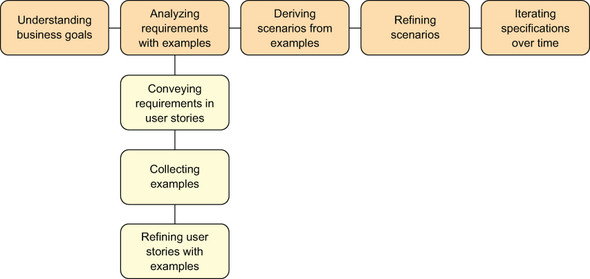
In general, answering questions at the top of the list will give you enough input to ask and answer the questions at the bottom. Such a practice—getting from business objectives to programmable solutions—is what SBE’s practitioners call deriving scope from goals. Over the last five years, deriving scope from goals emerged as probably the most important practice in the modern landscape of software development.

This is an excerpt from Manning's book Specification by Example: How Successful Teams Deliver the Right Software.
Many teams have also discovered that using Specification by Example to make requirements more precise at the start of a development cycle makes it easier to manage product backlogs. For example, being able to spot stories that are too vague or have too many gaps in required functionality early on prevents problems later. Without Specification by Example, teams often discover problems in the middle of an iteration, which interrupts the flow and requires time-consuming renegotiations—in larger companies, stakeholders who decide on the scope are often not readily available.

For most teams I work with, especially those in big companies, scope is something passed to them from a higher instance. Many teams think that it’s impossible to argue about business goals when they maintain only a piece of a large system. Even in those situations, understanding what the business users are trying to achieve can help you focus the project on things that really matter.