concept time in category software development

This is an excerpt from Manning's book Seriously Good Software: Code that works, survives, and wins.
First of all, often the users themselves don’t exactly know what services they need— they need time and assistance to figure that out. Second, fulfilling those needs isn’t the end of the story at all. Those services may be offered more or less quickly, with more or less accuracy, after a long user training or after just a quick glance at a well-designed UI, and so on. In addition, over time you need to modify, fix, or improve any system, which leads to more quality variables: How easy is it to understand the system’s inner workings? How easy is it to modify and extend it without breaking other parts? The list goes on and on.
Basic programming classes and even introductory computer science curricula overlook this fact. The latter deal extensively with time efficiency, particularly in algorithm and data structure classes. Those classes and their textbooks focus on one problem at a time, be it visiting a graph or balancing a tree. When you consider a single algorithmic problem, with given inputs and desired outputs, you can compare any two algorithms for performance. You may find that the fastest possible procedure is the one with the least asymptotic worst-case time complexity. This is indeed how research makes progress on single computational questions.
On the other hand, many real-world programming tasks, including our container example, aren’t like that. They don’t accept an input, compute an output, and then terminate. They ask you to design a number of interacting methods or functionalities that you may use repeatedly any number of times. Different data structures may favor one method over another, reducing the complexity of the first and slowing down the latter. For this reason, often there’s no all-around best solution, just different trade-offs.
I chose the total number of containers by trial and error so the running times would be long enough to show clear distinctions between implementations, and short enough to run the experiment repeatedly in a short amount of time. Table 3.5 reports the running times I get on my laptop. As expected, all classes from this chapter greatly outperform Reference, by as much as two orders of magnitude. In particular, our best attempt, Speed3 is 500 times faster. On the other hand, Speed2 is an order of magnitude slower than Speed1 and Speed3 (but still significantly faster than Reference). As I noted before, Speed2 is a rather odd implementation that only makes sense if getAmount queries are rare compared to the other operations. That’s not the case for the tested scenario.
   public void addEvent(E event, LocalTime startTime, LocalTime stopTime)
   {
      if (active)
         throw new IllegalStateException(
            "Cannot add event while active.");
      if (startTime.isAfter(stopTime))
         throw new IllegalArgumentException(
            "Stop time is earlier than start time.");
      TimedEvent timedEvent = new TimedEvent(event, startTime, stopTime);
      if (!events.add(timedEvent))  #1 Insertion fails in case of overlap
         throw new IllegalArgumentException("Overlapping event.");
   }


!@%STYLE%@!
{"css":"{\"css\": \"font-weight: bold;\"}","target":"[[{\"line\":9,\"ch\":36},{\"line\":9,\"ch\":38}]]"}
!@%STYLE%@!

This is an excerpt from Manning's book Writing Great Specifications: Using Specification by Example and Gherkin.
The result? The user and the application spoke two different languages, and the confused customer got lost. The dictionary of the developers who built the app was restricted to streets; after all, bus stops inherit their names from where they’re located. That’s how the system works, the team said. What they didn’t know was that their customers don’t think about the rules of a system—they only want to arrive on time.
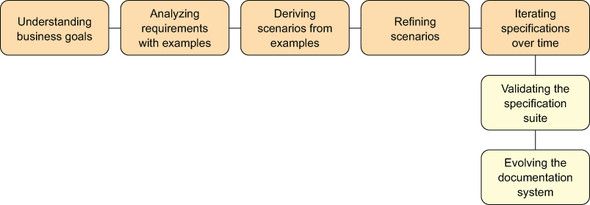
To see how feedback loops in SBE help uncover contradictions and uncertainty that can hide even in well-analyzed requirements, I’ll also talk about the life cycle of an executable specification. In product design, life cycle can be defined as the process of bringing a new product or a new feature to market and then maintaining it over time.
Listing 9.3. [BAD] Feature with loosely related scenarios added over time
Feature: Creating events Scenario: HR admins should be able to create company events 1 Given a Fortune 500 company like Coca-Cola And James, an HR admin in that company When James organizes a company-wide event: | name | date | time | | Annual staff picnic | 10-03-2017 | 10 AM | Then the employees in other departments should be notified Scenario Outline: Managing invited participants 2 Given James drafted a new event When he invites <invitee> Then only <invitee> should be notified about the invite But <uninvited> should not be notified Examples: Invites to one-on-one events such as annual reviews | invitee | uninvited | | Simona | Jane | Examples: Invites to local events in specific locations | invitee | uninvited | | Atlanta employees | New York employees | Examples: Inviting one department, but not the other (all locations) | invitee | uninvited | | engineers | salespeople | Examples: Inviting a specific department from a specific location | invitee | uninvited | | Atlanta engineers | New York engineers, salespeople | Scenario Outline: Managing simple events and serial events 3 Given a company-wide event called <name> And that it takes place <date> at <time> When Simona wants to attend the event Then she should get a reminder <date> before <time> Examples: | name | date | time | | Annual staff picnic | on 10-03-2017 | 10 AM | | Yoga classes | every Monday | 10 AM | Scenario Outline: Managing scheduling conflicts for company-wide events 4 Given a company-wide event created by James: | name | date | time | | Annual staff picnic | 10-03-2017 | 10 AM | And that Terry wants to organize another company-wide event: | name | date | time | | The Move with Purpose Marathon | 10-03-2017 | 10 AM | When Terry does <action> that the scheduling conflict is OK Then the event should be <result> And the employees in other departments should get <email> Examples: | action | result | email | | confirm | published | a notification | | not confirm | not published | no notification | Scenario: Managing scheduling conflicts for local events 5 Events from local branches shouldn't cause conflicts. Given an Atlanta event created by James: | name | date | time | | Local staff picnic | 10-03-2017 | 10 AM | When Terry wants to organize another event in New York: | name | date | time | | The Move with Purpose Marathon | 10-03-2017 | 10 AM | Then the event should be successfully published And the employees in other departments should be notified

This is an excerpt from Manning's book Agile Metrics in Action: How to measure and improve team performance.
Velocity —The relative performance of your team over time Changed lines of code (CLOC) —The number of lines of code that were changed over time
Perhaps the most obvious place to find data that points to your team’s performance is your PTS. Common PTSs include JIRA, Trello, Rally, Axosoft On Time Scrum, and Telerik TeamPulse. This is where tasks are defined and assigned, bugs are entered and commented on, and time is associated with estimates and real work. Essentially your project’s PTS is the intersection between time and the human-readable definition of your work. Figure 3.1 shows where this system lives in the scope of your application delivery lifecycle.
Estimating how long tasks will take can be pretty tricky in an agile world. It can be tough to figure out how long something can take when definitions are often in flux and products are constantly changing. Estimates are important from a project management perspective because they will eventually allow you to predict how much work you can get done in a certain amount of time. They also show you if your team really understands the work that they’re doing.
One thing that seems to always challenge teams is what estimations mean. Story points are supposed to relate to effort, yet every team I’ve ever been on ends up translating those points to time, so in most cases I find it easier for teams to use a time-based estimation. There are a plethora of blogs, articles, and chapters on the association of time and story points, but if there’s one thing I’ve learned it’s this: embrace whatever comes most naturally to your team. If your team estimates in time, then use days or half-days as story points. If they like the concept of effort, then go with it. If you try to fight whatever people understand as estimates, you’ll end up with numbers whose relativity constantly changes as you try to change their association of time to estimations. By embracing what comes naturally to your team, you may not end up with a textbook way of estimating your tasks, but you will end up with more reliable data over time.
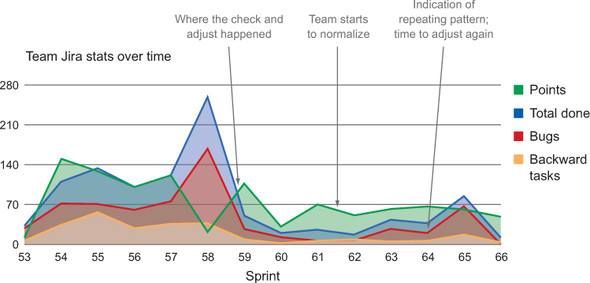
For teams I’ve managed it normally takes three to four iterations before they can start to trust their estimations. The best way to see if your estimations are on track is to look at them over time next to the total number of tasks that you complete over time.
Even if you get to a point where your estimations and completed work are consistent, using estimations alone can’t tell you if you are under- or overestimating. Overestimating work means your team is underachieving for some reason; underestimating typically leads to team burnout and an unsustainable pace of development. The tricky thing here is that estimations alone don’t give you that insight into your team; you have to combine estimations with other data to see how well your team is estimating. Figure 3.8 may look great to you if you’re trying to hit a consistent goal over time.

This is an excerpt from Manning's book Git in Practice.
shows the date and time when the commit was made.
Like git log, git reflog can be passed a ref as the final argument. If this isn’t specified, it defaults to HEAD. For example, you can view how the master branch has changed over time by using git reflog master.
This is an excerpt from Manning's book The Mikado Method.
This is the perfect moment for the Mikado Method to enter the scene. It’s a structured way to make significant changes to complex systems. Rather than getting caught up in the complexity of moving parts, analyzing the entire system in one large chunk, the Mikado Method lets you handle complex code a bit like you’d move furniture around in your home, one piece at a time. In the same way that you might need to move your table to fit in your sofa, and move the easy chair before you can move the table, you need to change and move methods and classes around before you can fit new functionality into your complex codebase. You need to do it one step at a time.
The key to the Mikado Method is removing the fewest obstacles at a time in order to achieve real results, without breaking the code. In this chapter, we’ll introduce you to the method, show you some of the benefits, and walk you through how it works.
The basic idea behind taking out a loan is to delay the payment for a purchase, from a time when you don’t have the purchasing power to a time when you do. Sometimes this means you pay back a little at a time over a longer period, perhaps over decades for expensive things such as a house. Sometimes it means you pay back everything in one lump sum quickly, within a week or sooner. Now, what has this got to do with software development?

This is an excerpt from Manning's book Kanban in Action.
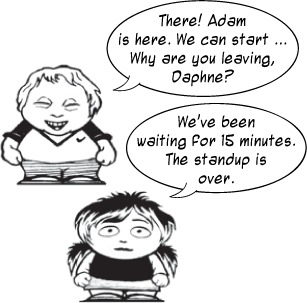
He almost didn’t have time to end the sentence before Adam, ever the skeptic, said, “Why? Shouldn’t we do as much as possible? Right now we’re showing the work we’re doing; we can’t do much about that. We’re going as fast as we can.”
Some teams find that their service-level agreements (SLAs) give them a clear target to strive toward, and other teams like to set a target themselves—for example, average lead time (or why not a little less?)—to track their progress against. This helps foster a mindset that time is of the essence, to flow the work faster. It can also give you the benefits of timeboxing.
Timeboxing is a simple technique that is used in many agile software development methods to manage risk and to focus on doing the things that matter most first. These methods often use iterations of a set length (for example, two weeks) to plan and review work. When the size of the team and the time allotted are both fixed, scope needs to be flexible, and you have to prioritize and build the most important things first. See chapter 9 for more on using iterations with kanban.
Keeping the meeting short also means it needs to start on time. There are all kinds of ways to try to get people to be on time,[6] but for most teams this doesn’t seem to be a problem as long as the things that are discussed in the meeting are important and engaging.
6 Including fines, people standing silently to wait for latecomers, and other things that feel pretty awkward when you think about it. We’re most likely dealing with adults; why not talk about the pros and cons of coming on time and pick a time that suits everyone, instead?

This is an excerpt from Manning's book Specification by Example: How Successful Teams Deliver the Right Software.
With such a high frequency of change, documentation quickly gets outdated. Detailed specifications and test plans require too much effort to keep current and are considered wasteful. People who relied on them for their day-to-day work, such as business analysts or testers, often become confused about what to do in this new world of weekly iterations. Software developers who thought they weren’t affected by the lack of paper documents waste time on rework and maintaining functionality that’s not required. Instead of spending time building big plans, they waste weeks polishing the wrong product.
Unfortunately, these ideas didn’t catch on at the time. Long development phases made them impractical to execute. People spent months trying to write abstract requirements for projects that would last years. Detailing everything upfront with examples would delay that even longer.
Agile development changed the way the industry thinks about software delivery phases—and shortened these phases significantly. This made Specification by Example feasible. Iteration and flow-based projects can benefit greatly from Specification by Example. With so little time to complete a delivery phase, we need to eliminate as much unnecessary work as possible. Common problems that require fixing are rework, duplicated tasks caused by miscommunication, time wasted working back from code in order to understand the system, and time spent repeatedly executing the same tests manually. Effective delivery with short iterations or in constant flow requires removing as many expected obstacles as possible so that unexpected issues can be addressed. Adam Geras puts this more eloquently: “Quality is about being prepared for the usual so you have time to tackle the unusual.” Living documentation simply makes common problems go away.
In the other two cases, teams focused on a tool, not on high-level collaboration and process changes. They ended up wasting a lot of time and effort building a suite of technical tests that business users and testers weren’t able to use. They paid a big price in terms of effort and time spent on test maintenance without any of the benefits of Specification by Example.
Keep one person on legacy scripts during migration: When: Introdu- ucing functional automation to legacy systems

Rewriting functional tests and automating them using a new tool takes time. Until the new validation system grows, any existing tests might need to be maintained and kept up-to-date. A good way to address this issue is to delegate that work to a single person and write off that person’s time while planning for the immediate future.

This is an excerpt from Manning's book Continuous Integration in .NET.
This definition contains an important phrase: “multiple integrations per day.” This means that several times each day, the CI system should build and test the application. But multiple integrations per day isn’t where you begin your journey into CI; we recommend against this because many shops not using CI will meet enough resistance just automating the build, let alone doing multiple builds per day. (We’ll talk more about overcoming team resistance later in this chapter.) Ideally, you should set up your CI process just as you create software: by taking small steps, one at a time.
CI means increased maintenance. Someone will have to maintain the CI system. This will take them away from programming duties. At first, there will be extra overhead to set up the system; but when a project is fully integrated, your team will save time because it will be faster and easier to test the application and detect and fix bugs. Many teams report that after the CI process is running, maintenance takes less than an hour per week.
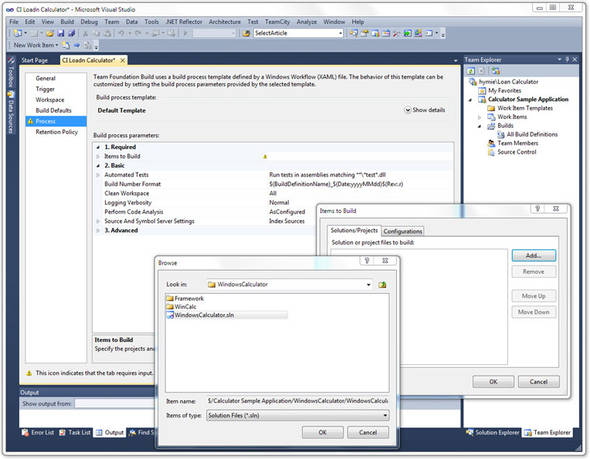
Figure 4.33. When you define a build in TFS, you can use XAML templates. For an ordinary CI process, you can use the default template; but if you want to customize this and that, it’s time to get some Workflow Foundation information (you can start at http://msdn.microsoft.com/en-us/vstudio/aa718795.aspx).

This is an excerpt from Manning's book Event Processing in Action.
One of the main themes in event processing is the detection and reporting of situations so that they can be reacted to. The reaction might be as simple as picking up the phone or changing the weekly shopping list, or it might be more complicated. If we miss a flight connection there may be several alternative reactions depending on the time of the day, the airport where we are stranded, the airline policies, and the number of other passengers in the same situation.
The way we view things in our daily life is affected by their context. This context can relate to the time of day; for example, at night you can open your car with the remote control from quite a long distance, but you may have to come quite close on a sunny day. Context can also relate to location: you might feel safe enough to carry money in your wallet in your own city, whereas in countries which have a reputation for muggings, you hide your money. Context may relate to other external conditions such as the state of the traffic. The route you choose to drive to the airport might depend on your knowledge of likely traffic conditions, or on congestion reports that you have picked up from the radio. In this chapter we introduce context as an explicit building block in our event processing model and dive deeply into the idea of context applied to event processing by covering the following topics:
A window is opened when the event processing agent receives a prespecified event (called the initiator). It closes when the event processing agent receives a prespecified event (the terminator). The initiator and terminator can be specified as specific event instances, or they can be specified more broadly, for example, the context could specify that any instance of a particular event type acts as an initiator. The window may also close even if a terminator event has not been detected, either when a given period of time has elapsed or when the window has reached a given size.

This is an excerpt from Manning's book Becoming Agile ...in an imperfect world.
All software projects have constraints. Similar to the situation during the Quecreek rescue, the number-one constraint is frequently time. The Quecreek rescue team had a few days to reach the miners. Software projects are often limited to a few days, weeks, or months, after which they’re of no value. Like a Sunday newspaper delivered on Monday, all the quality work and effort invested in the project are worthless if you don’t meet your most critical priority.
In the past, Acme Media delivered all software, both high- and low-priority features, in one delivery at the end of the project. The entire team didn’t help during development; it was solely up to the programmers to bring the features home. In this chapter, Acme will use its new iterative approach and deliver the highest-value features first. The team will deliver working software in batches until they run out of time or the customer need is satisfied.
When we left Acme Media, the team had just completed their iteration plan. They outlined one item for iteration 0, modifying the contract with eLertz to support an additional alert needed for the Auctionator. With this work out of the way, it’s time to focus on the features that are assigned to iteration 1.
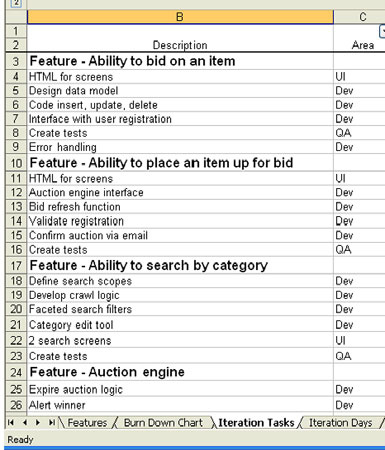
Figure 18.1. Acme Media’s backlog of work for iteration 1. In a perfect world, team members grab a task and begin working. In Acme Media’s world, the team is constrained by specializations, and some tasks can be completed only by certain team members or groups. Acme Media will cross-train, but it will take time for the team to mature to a point of no specializations.

This is an excerpt from Manning's book Test Driven: Practical TDD and Acceptance TDD for Java Developers.
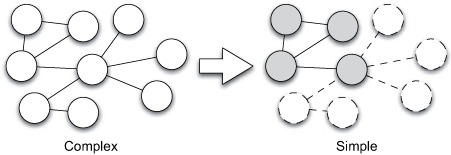
Figure 1.6 shows an incremental progression of working, tested functionality where the inventory of non-integrated, unfinished work is very small at any given point in time.
Listing 2.19. Writing a simple performance check to act as an early warning system
import org.junit.Test; import static org.junit.Assert.*; public class TestTemplatePerformance { // Omitted the setUp() for creating a 100-word template // with 20 variables and populating it with approximately // 15-character values @Test public void templateWith100WordsAnd20Variables() throws Exception { long expected = 200L; long time = System.currentTimeMillis(); template.evaluate(); time = System.currentTimeMillis() - time; assertTrue("Rendering the template took " + time + "ms while the target was " + expected + "ms", time <= expected); } }
First-hand experience is also important for understanding the why. Repeating a mantra such as “TDD is good for you” doesn’t go far in creating a lasting change. The change becomes real when we see with our own eyes how we just prevented an angry customer from busting in through the phone line because we wrote our tests first. We created the solution one small step at a time and realized something we wouldn’t have thought of if we had designed the whole solution up front.
In addition to change taking calendar time, change also takes the time of the change agent. With this in mind, we should avoid trying to support too many individuals simultaneously. It’s often easier to lead one person at a time or one team at a time through a change than to spread the change immediately to four teams and not be able to support any of the four teams properly. Furthermore, the more resistance we face from the individuals we are supporting, the fewer individuals we can support. After all, it takes a lot more effort, attention, and energy to support a resisting individual than it takes to guide an enthusiastic colleague to make the change.