liveBook · Manning

10GBASE-T

As explained in Acing the CCNA Exam: Volume 1 Fundamentals and Protocols

10GBASE-T is an Ethernet physical-layer standard that transmits 10 Gbps over four twisted-pair wire pairs.

10GBASE-T is an Ethernet physical-layer standard that carries 10 Gbps over copper unshielded twisted-pair (UTP) cable. It uses all four twisted pairs, totaling eight wires, through an 8P8C connector. section 3.3.2 section 3.5

Key points for cable selection:

  • Unlike 10BASE-T and 100BASE-T, which use two wire pairs, 10GBASE-T uses all four pairs. section 3.3.2
  • The maximum cable length is 100 meters for UTP Ethernet connection types. section 3.5
  • Twisting reduces electromagnetic interference between wires in each pair. section 3.5
Figure 3.7 Pin and wire pairs used on 1000BASE-T and 10GBASE-T connections. All eight wires of the cable are used.
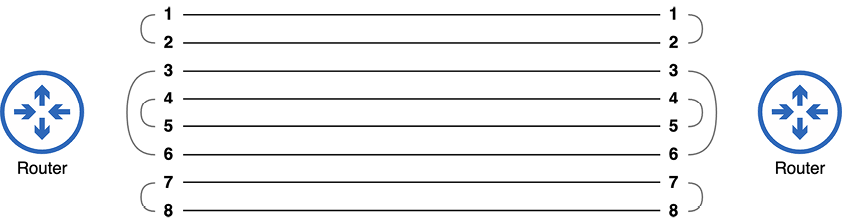
Use the pin-and-wire diagram to verify that 1000BASE-T and 10GBASE-T connections use all eight cable wires. section 3.3.2

How Acing the CCNA Exam: Volume 1 Fundamentals and Protocols covers it

How deep it goes
Explains pair usage, connector wiring, interference reduction, and distance, but does not detail signaling or encoding.
Examples
Uses a pin-and-wire diagram comparing 1000BASE-T and 10GBASE-T to show all eight wires in use.
What you can do after
Evaluate whether a copper Ethernet link uses the required four pairs and remains within the 100-meter limit.
How it connects
Connects 10GBASE-T with UTP, 8P8C connectors, Auto MDI-X, 1000BASE-T, and fiber-optic cabling.

Related concepts

This explainer was generated by Manning's knowledge graph from the text of Acing the CCNA Exam: Volume 1 Fundamentals and Protocols. The section links point to the parts of the book it draws on.