A 3D image extends a 2D raster picture into space. Like pixels, its basic units are voxels—volume pixels arranged as a regular three-dimensional grid. You can picture it as an array of 2D images, or as a perfect, aligned image stack. section 12.0
Figure 12.1 The same data (a) represented as an array of colors: a 2D 4×2 image made of pixels (b) and a 3D 2×2×2 image made of voxels (c)
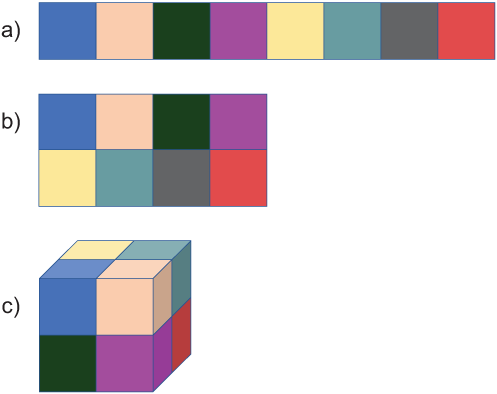
Compare a 2D 4×2 pixel image with a 3D 2×2×2 voxel image to see how the same array-like idea gains a spatial dimension. section 12.0
Most 3D images are grayscale stacks produced by tomography rather than color photographs. Gray values encode measurements, such as information gathered from X-rays. Since raw intensities are awkward for geometric operations, segmentation extracts regions into image masks: equal-sized grids whose bits mark whether each voxel belongs to the selected part. section 12.0
Voxel representations are especially useful when:
- Boolean operations must be fast and reliable, provided the operands use the same voxel grid. section 12.8
- Erosion and dilation provide voxel analogues of offsets used with signed distance functions and boundary representations. section 12.8
- Image vectorization converts voxel data into other geometric representations, supporting workflows that move among voxels, signed distance functions, and boundary representations. section 12.8