A policy against unapproved AI tools does little if employees can still use them to process sensitive information. The six-level governance (6L-G) model connects policy to controls that teams can build, test, monitor, and revise throughout a generative AI system’s lifecycle. section 3.9 section 1.3
The six levels turn governance decisions into operational checkpoints:
- 1. Strategy & Policy: Define permitted uses, risk appetite, accountability, exception approval, and the process for proposing projects. section 3.9
- 2. Risk & Impact Assessment: Review each proposal, assign a risk tier, and set operating conditions, including vendor contract requirements. section 3.9
- 3. Design & Implementation Review: Check the architecture against requirements and track each required condition as an engineering task. section 3.9
- 4. Launch Readiness Review: Test safety and compliance controls on the final release candidate and decide whether it may launch. section 3.9 section 3.1
- 5. Operations & Monitoring: Oversee the live system using configuration records, request logs, complaints, and other operational evidence. section 3.9
- 6. Learning & Improvement: Use incidents, audit findings, and feedback to update the policy, design, process, test, or guardrail that needs to change. section 3.1 section 3.9
Figure 3.1 The six governance levels before and after go-live. Level 6 routes operational findings back to the policy, assessment, implementation, or test that must change.
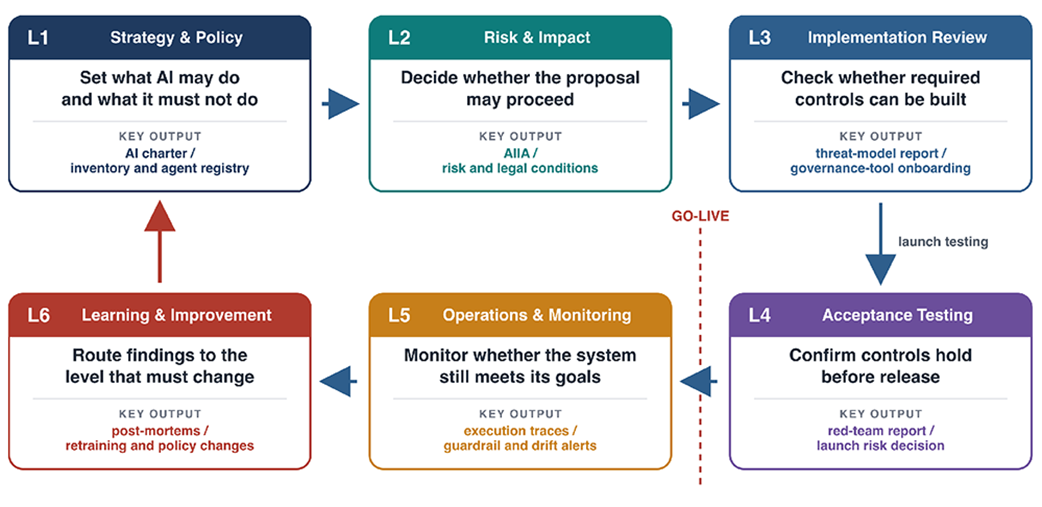
The lifecycle view distinguishes pre-launch checkpoints from operational oversight and shows how findings return to earlier decisions. section 3.1
Controls must account for shared responsibility: developers secure model weights and disclose risks, integrators configure guardrails and monitoring, and end-user organizations accept or reject residual risk. A shared technical layer can enforce rules, but it cannot anticipate every harmful outcome; consequential uses still need testing before release and observation afterward. section 1.3 section 8.4
Applying the model to erasure
For a GDPR erasure request, policy can set rules for identifiable training data; assessment can map personal data in tables and vendor logs; and implementation review can check pseudonymization and model versioning. Acceptance testing can then probe whether deleted records are exposed through membership-inference attacks. section 1.3
Governance maturity depends on execution. A baseline includes documented policy, controls, roles, escalation paths, and an incident response process. More advanced practice tracks metrics and uses incidents to improve controls. The framework organizes obligations but does not replace applicable legal or regulatory requirements. section 3.1 section 8.4
